Building a Home in Costa Rica: Complete Guide for Families (2026)


Building a home in Costa Rica is a dream for many families.
A house surrounded by rainforest. A terrace where mornings begin with birdsong.
Children running barefoot through the garden. Fruit trees. Fresh air. Ocean views.
Maybe a river nearby. Maybe a home built with solar power, rainwater, natural ventilation and enough space to live more independently.
For many families, building in Costa Rica is not just about construction.
It is about creating a completely different lifestyle.

But building here is also very different from building in Europe, North America or other parts of the world. The climate is different. The materials behave differently.
The timelines can feel different. The paperwork can be confusing.
The workers, architects, engineers, municipalities and expectations may not work the way you are used to. And if you are building in the tropics for the first time, there are many things you may not even know to ask.
This guide is written for families who are thinking about building a home in Costa Rica and want a realistic, practical and honest overview before they begin.
It is not legal advice.
It is not engineering advice.
And every project should be checked with qualified local professionals.
But it will help you understand the biggest decisions, common mistakes, cost factors and practical realities before you start building your dream home.
Table of Contents
1. Is Building a Home in Costa Rica Right for You?
Before you think about floor plans, builders or materials, ask yourself a deeper question:
Do we actually want to build — or do we simply want the finished home?
Those are two very different things.
Building a home in Costa Rica can be incredibly rewarding, but it also requires patience, flexibility and emotional stamina.
Things may take longer than expected.
Materials may not always be available when you need them.
Communication can require extra attention, especially if you do not speak Spanish fluently.
Weather can affect progress.
Road access can complicate deliveries.
And decisions that seem small in the beginning can become expensive later.
For some families, buying an existing home is the better option.
For others, building is the only way to create the life they truly want.
Building may be right for your family if:
You want a home designed specifically for tropical living.
You want land, space and privacy.
You are patient with long-term projects.
You are willing to make many decisions.
You enjoy creating something from the ground up.
You want the freedom to design your lifestyle intentionally.
You understand that building is a journey, not just a transaction.
Building may be more challenging if:
You need everything finished quickly.
You are uncomfortable with uncertainty.
You expect construction to work exactly like it does back home.
You are building from abroad without someone trusted on-site.
You do not want to manage details.
You are working with a very tight budget and no flexibility.
The truth is simple:
Building in Costa Rica can be beautiful.
But it is rarely effortless.
The families who enjoy the process most are usually those who see building as part of the adventure.
They are not only trying to create a house.
They are creating a home that fits the land, the climate and the life they want to live.
Before You Build: 10 Questions Every Family Should Answer First
What is our total budget?
How much land do we actually need?
Are we building for today or the next 20 years?
Do we want to be off-grid?
Do we want a pool?
Will we work remotely?
Will our parents visit?
How many bedrooms do we really need?
Could we start smaller and expand later?
How much maintenance do we want?
2. Buy the Right Land Before You Build
The success of your future home begins long before construction starts.
It begins with the land.
A perfect house on the wrong property can become a daily frustration.
Before buying land to build on, you need to understand more than the view.
You need to check:
Legal title.
Land use.
Water access.
Road access.
Flood risk.
Soil and drainage.
Building restrictions.
Protected areas.
Utility options.
Internet availability.
Neighbours and surrounding development.
A property may look beautiful during a short visit, but building will reveal every weakness.
If the road is difficult, deliveries become expensive.
If the land floods, foundations become complicated.
If there is no legal water, permits may become difficult.
If the soil is unstable, engineering costs rise.
If the land is too steep, construction may require retaining walls, special foundations or expensive earthworks.
If the property is too close to rivers, protected areas or the maritime zone, restrictions may limit what you can build.
This is why land due diligence is not separate from the building process.
It is the foundation of it.
Before committing to land, walk the property with people who understand construction.
Bring a builder, architect, engineer or experienced local professional if possible.
Ask them practical questions:
Where would you build?
How would trucks access the site?
Where would water come from?
Where would wastewater go?
How would rainwater drain?
Where would the sun hit the house?
Where does wind come from?
What would make construction expensive here?
What would worry you about this property?
A good property should inspire you emotionally and make sense practically.
You need both.
Before planning your dream home, make sure you've chosen the right property. Our complete guide to buying land in Costa Rica covers everything you need to know—from finding land and verifying titles to water rights, legal checks, flooding risks and common mistakes foreign buyers should avoid.
3. Understanding Building Permits in Costa Rica
Building permits in Costa Rica can feel confusing at first because several institutions may be involved.
The exact process depends on the municipality, the project size, the land, environmental factors and the type of construction.
In general, formal construction projects usually involve:
A licensed architect or engineer.
Technical plans.
CFIA review.
Land-use confirmation.
Water and wastewater documentation.
Municipal review.
Construction permit approval.
Environmental review, if required.
The CFIA, Costa Rica’s professional association for engineers and architects, plays an important role because construction plans are normally submitted by licensed professionals.
A municipality then reviews the project before issuing the municipal construction permit.
Some projects may also require environmental review through SETENA, especially larger projects or projects in sensitive areas.
For a family building a single home, the process may be simpler than for a commercial development, but it still needs to be taken seriously.
Before you start building, ask your architect or engineer:
What permits are required for this specific property?
Does the municipality have a regulatory plan?
Is SETENA required?
What documents are needed?
How long does the process usually take in this canton?
What fees should we expect?
Can we legally build the size and type of house we want?
Are there setbacks from roads, rivers or protected areas?
Are there restrictions because of slope, forest, water sources or zoning?
The most important thing is not to rely on general advice.
Costa Rica is highly local.
What works in one area may not work the same way in another.
Always ask professionals who understand the specific municipality where your land is located.
Building at Finca MiraVida
One advantage of building at Finca MiraVida is that you don't have to figure everything out on your own.
As we are going through the building process ourselves, we're continuously learning how the local procedures work, which professionals are reliable, what documents are typically required and what challenges first-time builders often encounter.
While every family remains responsible for complying with all applicable laws and local requirements, we're happy to share our experience, recommend trusted local contacts and help our future neighbours navigate the process with much more confidence.
Sometimes simply having someone nearby who has already asked the same questions can save countless hours of research, unnecessary stress and expensive mistakes.
We hope that, over time, MiraVida becomes a place where neighbours don't just live side by side—they also share knowledge, support one another and make the journey of building a home in Costa Rica a little easier for everyone.
4. How Much Does It Cost to Build a Home in Costa Rica?
This is probably the question we receive more than any other.
"How much does it cost to build a home in Costa Rica?"
The honest answer is:
There is no single answer.
Unlike many countries where most houses are built in a similar way, Costa Rica offers an incredible amount of flexibility.
You can build:
a small prefabricated starter home
a simple concrete family house
a modern tropical villa
a luxury architectural home
or even build gradually over several years as your budget allows.
That flexibility is one of the reasons many families are able to make their dream of living in Costa Rica a reality.
Forget "Price per Square Meter"
Many websites will tell you:
"Building costs between US$1,500 and US$3,000 per square meter."
While that may be true for many professionally managed custom homes, it certainly doesn't tell the whole story.
A family building a simple home, managing parts of the project themselves or choosing a prefabricated house can often spend significantly less.
Instead of asking:
"How much does building cost?"
A better question is:
"What type of home do we actually want to build?"

Typical Building Budgets in Costa Rica
Type of Home | Approximate Total Construction Budget | Ideal For |
Small Prefabricated Shell | From US$8,000–15,000 | Weekend cabin, guest house or a simple starter project. Usually includes only the basic structure and requires additional finishing work. |
Finished Small Prefabricated Home | US$20,000–45,000 | Couples or small families looking for an affordable, move-in-ready home with basic finishes. |
Simple Owner-Built Family Home | US$40,000–90,000 | Families who are willing to manage parts of the project themselves, choose a simple design and focus on practicality over luxury. |
Standard Turnkey Family Home | US$120,000–250,000+ | Families looking for a professionally managed project with modern finishes, quality materials and minimal involvement in the construction process. |
Luxury Custom Tropical Home | US$300,000+ | Architect-designed homes with premium materials, custom features, large glass walls, pools and high-end finishes. |
Important: These are broad examples only and should be used as rough planning estimates rather than fixed prices. Final construction costs depend on the location, house size, design complexity, materials, labour, accessibility, site preparation, permits, engineering requirements and the level of finishes you choose.
The Good News
One of the biggest misconceptions about building in Costa Rica is that you need a huge budget.
In reality, there are many different ways to build.
Some families start with a modest prefabricated home and expand it over time.
Others build a simple concrete house and finish it gradually as their budget allows.
And some choose a fully custom-designed tropical home from the very beginning.
There is no "right" way to build in Costa Rica. The best home is the one that fits your family's lifestyle, priorities and budget—not someone else's expectations.
A Real Example
Our own guest house is a great example of how different construction budgets can be.
It is a relatively simple building designed for practical living rather than luxury.
The total construction cost was approximately €10,000–15,000 (excluding the land).
Of course, it isn't comparable to a large custom-designed family home, but it demonstrates something important:
Building in Costa Rica doesn't automatically require hundreds of thousands of dollars.
With realistic expectations, a practical design and a willingness to be involved in the project, building can be far more affordable than many people initially believe.
What Changes the Price the Most?
Surprisingly, square meters are only one part of the equation.
The biggest cost differences usually come from decisions like these:
Decision | Lower Cost | Higher Cost |
Home Size | Smaller footprint | Large custom home |
Design | Simple rectangular layout | Complex architectural design |
Construction Method | Prefabricated or owner-built | Full turnkey custom build |
Finvolvement | Managing parts yourself | Hiring one company for everything |
Finishes | Local materials | Imported luxury finishes |
Windows | Standard aluminum | Large custom glass walls |
Roof | Simple roof | Multiple roof lines |
Site | Flat land | Steep hillside with retaining walls |
Access | Easy road access | Remote property requiring heavy earthworks |
Many people focus on expensive countertops or designer bathrooms.
In reality, terrain, drainage, foundations and accessibility often have a much bigger impact on the final budget.
Hidden Costs Many Buyers Forget
When people calculate the cost of building a home, they often focus only on the house itself.
In reality, there are many additional expenses that are easy to overlook during the planning stage. Depending on your property, some of these costs can become a significant part of your overall budget.
Hidden Building Cost | Why It Matters |
Site Preparation | Clearing vegetation, grading the land and preparing the building site before construction begins. |
Driveway | Especially important on rural properties where access roads may need to be improved for construction vehicles. |
Retaining Walls | Sloped properties may require retaining walls to stabilize the terrain and create usable building areas. |
Drainage Systems | Proper drainage is essential in Costa Rica's tropical climate to prevent flooding and protect your home's foundation. |
Rainwater Management | Gutters, downpipes and drainage channels help safely direct heavy tropical rainfall away from your home. |
Septic System | Most rural homes require their own septic system and drainage field. |
Water Tanks & Pumps | Water storage tanks and pressure pumps improve reliability and ensure a steady water supply. |
Electricity or Solar Installation | Connection costs vary depending on your location and whether you choose an off-grid solar system. |
Internet Installation | Fiber, Starlink or mobile internet may require additional equipment or installation costs. |
Architect & Engineering Fees | Professional design, structural calculations and technical plans are essential and often underestimated. |
Furniture & Appliances | Kitchens, lighting, furniture and household appliances can add a surprisingly large amount to your final budget. |
Landscaping & Fencing | Gardens, fencing, pathways, retaining structures and outdoor living spaces are often left out of the initial budget but greatly improve daily life. |

One of the biggest budgeting mistakes first-time builders make is planning only for the construction of the house itself.
A realistic budget should include everything needed to comfortably move into your new home—not just the walls and roof.
As a general rule, we recommend keeping an additional 10–20% contingency fund for unexpected expenses. Construction projects rarely go exactly as planned, and having financial flexibility will make the entire experience much less stressful.
Ich finde übrigens, wir können diesen ganzen Abschnitt noch auf ein neues Level bringen.
Anstatt nur über Kosten zu sprechen, könnten wir darunter noch ein Kapitel einfügen:
Where Can You Save Money Without Sacrificing Quality?
Darin könnten wir Tipps geben wie:
✅ Build a simpler roof (one of the biggest cost savers).
✅ Keep the house compact instead of adding unnecessary hallways.
✅ Invest in a large covered terrace instead of increasing indoor square footage.
✅ Use locally available materials whenever possible.
✅ Design your home so it can be expanded later if your family grows.
✅ Consider a prefabricated home if you're on a tighter budget.
✅ If you have the skills and time, managing parts of the project yourself can significantly reduce costs.
✅ Spend money on the structure, roof and waterproofing first—luxury finishes can always be upgraded later.
Budget Advice We Wish Someone Had Given Us
After talking with many people who have built in Costa Rica—and planning our own projects—we've learned one simple lesson:
Build the lifestyle first.
Not the biggest house.
A thoughtfully designed 50–100 m² home with a large covered terrace often provides a much better quality of life than a huge house that stretches your budget and increases maintenance.
Costa Rica naturally encourages outdoor living.
Many families discover that their terrace becomes the room they use the most.
Instead of trying to build your "forever dream home" immediately, consider building a comfortable home that fits your current needs and leaves room to expand in the future.
Budget Rule of Thumb
A useful way to think about your budget is:
House Construction+ Site Preparation+ Water & Septic+ Utility Connections+ Furniture & Appliances+ Landscaping+ 10–20% Contingency= Your Real Building BudgetOne of the biggest mistakes first-time builders make is budgeting only for the house itself.
A realistic budget creates peace of mind—and makes the entire building journey much more enjoyable.
5. Choosing the Right Architect or Designer
A good architect in Costa Rica does much more than draw a beautiful house.
They help translate your dream into something that can actually be built on your land, in your climate, under local regulations and within your budget.
This is especially important in the tropics.
A home that works beautifully in Germany, Canada or the United States may perform badly in Costa Rica.
Tropical homes need to think about:
Rain.
Humidity.
Sun exposure.
Ventilation.
Shade.
Roof overhangs.
Drainage.
Insects.
Mold prevention.
Indoor-outdoor living.
Material durability.
Maintenance.
When choosing an architect or designer, ask:
Have you designed homes in this region before?
Do you understand local climate conditions?
Can we visit completed projects?
Do you work with CFIA submissions?
How do you help with permits?
Do you design for natural ventilation?
How do you control construction costs?
Can you work with a realistic family budget?
How involved are you during construction?
Do you have trusted engineers and builders?
A beautiful design is not enough.
Your home must be buildable, comfortable and durable.
The best tropical architecture often looks simple from the outside, but every detail has been carefully considered.
Where does rainwater go?
How does the house stay cool?
Where does morning sun enter?
Where does afternoon heat hit?
Where can children play during rain?
Where do wet shoes, muddy feet and beach towels go?
These details shape everyday life.
6. Choosing Builders in Costa Rica
Finding the right builder may be one of the most important decisions of your entire project.
A great builder can make the process smoother, calmer and more predictable.
The wrong builder can turn your dream into stress.
Before hiring anyone, take your time.
Do not choose based only on price.
Do not choose only because someone seems friendly.
Do not choose only because they can start immediately.
Look for:
Experience in the region.
Finished projects you can visit.
Clear communication.
References from previous clients.
Written estimates.
Transparent payment schedules.
Understanding of tropical construction.
Respect for plans and engineering.
Good relationships with local workers.
Realistic timelines.
Ask to see previous homes.
Talk to past clients if possible.
Ask what went well and what went wrong.
Every construction project has challenges.
A trustworthy builder will not pretend otherwise.
They will explain how they handle problems.
You should also be clear about your own expectations.
Do you want a turnkey builder who handles almost everything?
Do you want to manage the process yourself?
Do you want a hybrid approach?
Each model requires a different type of builder.
The cheapest builder is not always the best choice.
A low initial quote can become expensive if materials are poor, timelines stretch endlessly or work needs to be redone.
Quality matters.
So does trust.
30 Questions to Ask Before Hiring a Builder
Hiring the right builder may be the single most important decision you make during your entire construction project.
Don't be afraid to ask difficult questions.
A professional builder should be happy to answer them.
Experience
How many homes have you built in Costa Rica?
Have you built homes in this region before?
Can we visit completed projects?
Can we speak with previous clients?
What type of homes do you specialize in?
Construction Process
How do you estimate construction costs?
How do you handle changes during construction?
What happens if unexpected problems arise?
How often will we receive progress updates?
Who supervises the construction site every day?
Timeline
When can construction begin?
How long do you realistically expect the project to take?
What typically causes delays?
How do you work during the rainy season?
Budget
What is included in your quotation?
What is NOT included?
How do you handle cost overruns?
What payment schedule do you use?
Do you provide written contracts?
Quality
What materials do you recommend?
How do you protect the house from humidity?
What waterproofing methods do you use?
How do you ensure good drainage?
What warranty do you provide?
Communication
Who will be our main contact?
How quickly do you normally respond?
Can we receive regular photo or video updates?
How are decisions documented?
How do you resolve disagreements?
Final Question
Perhaps the most important question of all:
"If this were your own family home, what would you do differently?"
The answer often tells you more than any portfolio ever could.
Builder Red Flags
🚩 wants huge deposit
🚩 no references
🚩 no written contract
🚩 "don't worry"
🚩 won't answer questions
🚩 impossible timelines
🚩 cash only
🚩 avoids engineer
🚩 won't let you visit projects

7. Turnkey, Owner-Managed, Hybrid or Prefab?
There is no single best way to build in Costa Rica.
The right approach depends on your budget, experience, time, location and how involved you want to be.
Most families choose one of four paths:
Turnkey Construction
A turnkey builder manages the entire process from plans to finished home.
This is often the easiest option for families living abroad or people who do not want to manage daily decisions.
The advantage is convenience.
The disadvantage is usually higher cost and less control.
Owner-Managed Construction
With owner-managed construction, you take a much more active role.
You may hire local workers directly, source materials, coordinate trades and make many day-to-day decisions yourself.
This can reduce costs and give you more control, but it also requires time, organization and confidence.
This is closer to the approach we are taking ourselves.
For us, being involved in the building process allows us to understand every decision, choose materials carefully and create a home that truly reflects our vision.
It is not the easiest path.
But for hands-on families, it can be deeply rewarding.
Hybrid Build
Many families choose something in between.
They hire professionals for key parts of the project, such as foundations, structure, electrical, plumbing and roofing, while managing other parts themselves.
This can offer a practical balance between control and professional support.
Prefabricated Homes
Prefab homes are becoming increasingly interesting in Costa Rica.
Modern prefab is not what many people imagine.
Some companies now offer beautiful, well-designed homes that can reduce construction time and create more predictable budgets.
Prefab can be a good option if:
You want faster construction.
You want clearer pricing.
You prefer a proven design.
You want less on-site complexity.
You are building from abroad.
However, you still need to check the same fundamentals:
Is the design suitable for tropical climate?
What foundation is required?
What is included in the price?
Who handles permits?
What is not included?
How are utilities connected?
What happens if the site is difficult?
Can the company show completed homes?
Are materials durable in humidity and rain?
Prefab can be excellent.
But not all prefab companies are equal.
Due diligence matters here too.
Building Options in Costa Rica
Building Option | Cost | Build Speed | Involvement | Customization | Best For |
Turnkey Construction Company | ⭐⭐⭐⭐ | ⭐⭐⭐⭐⭐ | ⭐ | ⭐⭐⭐ | Families who want a fully managed process and prefer convenience over control. Usually the most expensive option, but often the easiest. |
Owner-Managed Construction | ⭐⭐ | ⭐⭐ | ⭐⭐⭐⭐⭐ | ⭐⭐⭐⭐⭐ | Hands-on families who want full control over design, materials and quality while potentially reducing costs. |
Prefabricated Home | ⭐⭐⭐ | ⭐⭐⭐⭐⭐ | ⭐⭐ | ⭐⭐⭐ | Families who want a faster and more predictable building process with modern design options. |
Hybrid Build | ⭐⭐⭐ | ⭐⭐⭐ | ⭐⭐⭐ | ⭐⭐⭐⭐ | Families who want a balance between professional support and personal involvement. |
How to read this table:⭐ = lower / less⭐⭐⭐⭐⭐ = higher / more
There is no universally best option.
The best path is the one that matches your personality, budget, available time and tolerance for uncertainty.

Building at Finca MiraVida
One of the biggest challenges when building in Costa Rica is simply knowing where to start.
Every location has its own reality.
Different terrain.
Different access.
Different people.
Different local processes.
Different professionals.
Families at Finca MiraVida benefit from something that is difficult to find when buying isolated land: shared experience.
We are building here ourselves.
We are learning which materials work well, which local professionals are reliable, how tropical design decisions affect daily life and what mistakes are worth avoiding.
Every family remains responsible for their own project and for complying with the applicable legal and local requirements.
But having experienced neighbours nearby can make the journey feel far less overwhelming.
You are not buying a finished house.
You are not being told exactly what to build.
Instead, you have the opportunity to create your own home on your own land while being surrounded by people who understand the same journey.
Private land.
Shared values.
Helpful neighbours.
For many families, that balance is exactly what makes building at MiraVida so special.
8. Tropical Architecture: Build With Nature, Not Against It
One of the biggest mistakes foreigners make is designing a home for the climate they came from instead of the climate they are moving to.
Costa Rica is tropical.
That changes everything.
Your biggest challenge is usually not keeping the house warm.
It is keeping it cool, dry and comfortable throughout the year.
The best tropical homes work with nature rather than trying to fight it.
Instead of relying heavily on air conditioning, they use:
Natural cross ventilation
High ceilings
Large roof overhangs
Covered terraces
Strategic shade
Good insulation where appropriate
Thoughtful orientation towards the sun and prevailing winds
A well-designed tropical home often feels significantly cooler than one that simply uses expensive air conditioning.
Design Features Worth Considering

Large covered outdoor living spaces
Deep roof overhangs to protect walls from rain
High ceilings for better airflow
Large windows that open completely
Mosquito screens
Ceiling fans
Covered walkways
Durable outdoor materials
Good drainage around the house
Storage for muddy boots, surfboards and gardening equipment
Remember:
In Costa Rica you don't only live inside your house.
Much of your life happens outdoors.
Design your home accordingly.
Design Mistakes We Would Personally Avoid
Giant west-facing glass walls.
Tiny roof overhangs.
Dark roofs without insulation.
No covered entrance.
No outdoor storage.
Small terrace.
No mosquito screens.
No cross ventilation.
The Perfect Family Floor Plan for Comfortable Living in Costa Rica

9. Choosing the Right Building Materials
Every material has advantages and disadvantages.
There is no universally "best" material.
The best choice depends on:
Climate
Budget
Maintenance
Personal preference
Location
Builder experience
Concrete Block
The most common construction method in Costa Rica.
Advantages:
✅ Durable
✅ Termite resistant
✅ Hurricane resistant
✅ Fire resistant
✅ Long lifespan
Disadvantages:
Can become warm without proper ventilation
Requires good waterproofing
Heavy construction
Steel Construction
Increasingly popular.
Advantages:
✅ Fast construction
✅ Straight walls
✅ Excellent structural strength
✅ Less susceptible to termites
Disadvantages:
Requires experienced builders
May cost more depending on the project
Wood
Beautiful but requires careful planning.
Advantages:
✅ Warm atmosphere
✅ Sustainable when sourced responsibly
✅ Natural appearance
Disadvantages:
Requires maintenance
Some species attract insects
Humidity can create problems if poor-quality wood is used
Not every type of wood performs equally well in tropical climates.
Bamboo
Beautiful for selected applications.
Mostly decorative or specialty construction.
Requires experienced professionals.
Mixed Construction
Many of the nicest homes combine materials.
Concrete structure.
Wood ceilings.
Steel roof.
Stone walls.
Natural finishes.
The combination often creates both durability and beauty.

10. Solar Power, Water & Off-Grid Living
One reason many families move to Costa Rica is the dream of becoming less dependent on outside systems.
That doesn't necessarily mean living completely off-grid.
Many homes combine modern comfort with greater self-sufficiency.
Solar Energy
Solar has become increasingly attractive.
Questions to ask:
How much sun does the property receive?
Is battery storage necessary?
Will you stay connected to the grid?
What is your daily electricity usage?
Will you use air conditioning?
Electric vehicle?
Pool pumps?
A professional solar assessment can save thousands later.
Water
Possible water sources include:
ASADA
Municipal water
Registered well
Legal spring
Rainwater collection (usually as a supplement)
Never assume water availability.
Verify everything before building.
Septic Systems
Many rural homes use septic systems.
A proper soil study helps determine:
Drainage
Absorption
Septic location
Long-term performance
Poor planning here can become very expensive later.
Rainwater Harvesting
Although rainfall is abundant, storage systems still need planning.
Collected rainwater can often be used for:
Garden irrigation
Toilets
Washing
Emergency backup
Internet
Remote work has become much easier.
Many rural families now use:
Fiber Internet (where available)
Starlink
Mobile backup connections
Always test internet before purchasing land if remote work is important.
11. How Long Does It Take to Build a Home in Costa Rica?

One of the most common questions families ask is:
"How long does it actually take to build a home in Costa Rica?"
Just like construction costs, there isn't one simple answer.
The timeline depends on many factors, including:
The type of home you build
Whether you choose a prefabricated or traditional construction
The size and complexity of the project
The weather
Site preparation
Material availability
Permit requirements
Your own involvement in the project
A small prefabricated home can sometimes be completed in just a few weeks once the site is ready, while a custom-designed family home may take a year or longer.
Typical Construction Timelines
Type of Project | Typical Time |
Small Prefabricated Home | 1–2 months |
Medium Prefabricated Family Home | 2–4 months |
Simple Owner-Built Home | 4–8 months |
Standard Concrete Family Home | 6–12 months |
Large Custom Tropical Home | 12–18+ months |
Important: These are general examples only. The timeline begins once planning, permits (where required) and site preparation have been completed.

Planning Often Takes Longer Than Construction
Many people assume the building itself is the longest part of the journey.
In reality, choosing the right land, designing your home, finalizing the plans, selecting builders and organizing everything can often take as long—or even longer—than the construction itself.
Taking your time during the planning phase usually leads to a smoother build and far fewer expensive surprises.
Site Preparation Can Make a Huge Difference
Two identical houses can have completely different construction timelines.
A flat property with good road access may be ready to build within days.
A steep jungle property might first require:
Land clearing
Earthworks
Drainage
Driveway construction
Utility installation
Retaining walls
Sometimes preparing the land is the biggest project of all.
Building During the Rainy Season
Many people assume you should only build during the dry season.
The reality is quite different.
Construction takes place all year round in Costa Rica.
Experienced builders know how to work around tropical weather, adjusting schedules when necessary.
In fact, building during the rainy season has one unexpected advantage:
You immediately see how your land handles heavy rainfall.
You'll quickly discover:
Where water naturally flows
Whether drainage works properly
If there are areas prone to flooding
Whether additional improvements are needed
Many homeowners consider this valuable information before moving in.
Don't Rush the Process
It can be tempting to finish everything as quickly as possible.
But building a home is one of the biggest investments most families will ever make.
A few extra weeks spent planning, checking details and making thoughtful decisions can save months of frustration later.
Build carefully.
Build intentionally.
Your future self will thank you.
How We See It at Finca MiraVida
One of the things we love about Costa Rica is that there isn't just one way to build. Some families may start with a small prefabricated home and move in within a few months. Others prefer to build their dream home step by step over several years. We believe both approaches are equally valid. The goal isn't to build the biggest house as quickly as possible. It's to create a home that allows your family to start living the life you've been dreaming about.

12. Common Building Mistakes
Building mistakes are usually not caused by bad luck.
They happen because people don't know what questions to ask.
Mistake #1
Choosing land before understanding construction.
The cheapest land often becomes the most expensive to build on.
Mistake #2
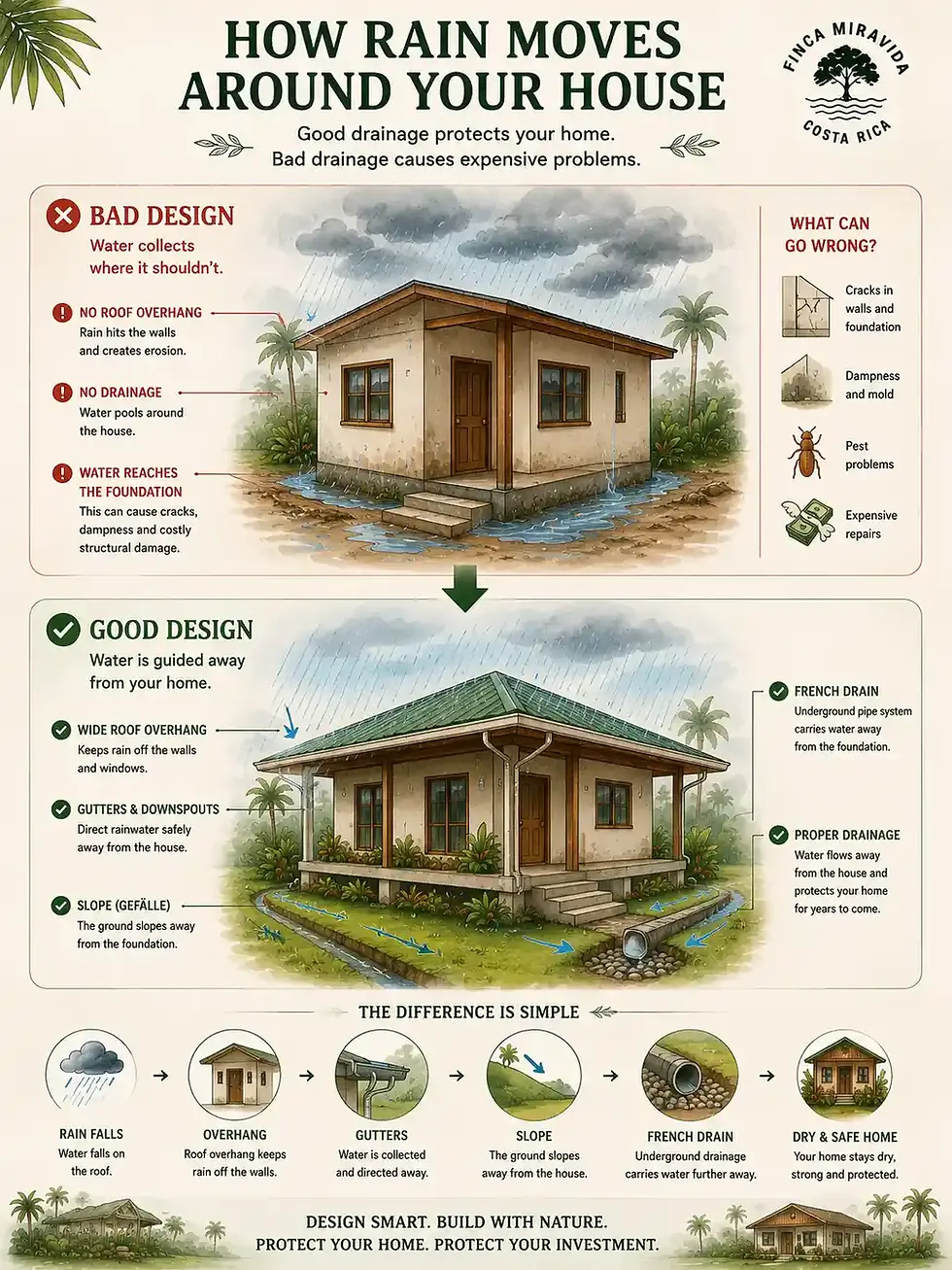
Ignoring drainage.
Water always wins.
Design your house around it.
Mistake #3
Designing a European house.
Costa Rica is tropical.
The house should be too.
Mistake #4
Not visiting during rainy season.
One afternoon of heavy rain can teach you more than ten sunny visits.
Mistake #5
Hiring only by price.
Cheap builders often become expensive builders.
Mistake #6
Changing plans during construction.
Every change costs money.
Finalize decisions early.
Mistake #7
No contingency budget.
Unexpected costs happen.
Plan an additional 10–20% if possible.
Mistake #8
Too little storage.
Families accumulate:
Bicycles.
Surfboards.
Tools.
Garden equipment.
Children's toys.
Build more storage than you think you'll need.
Mistake #9
Not planning for outdoor living.
In Costa Rica your terrace may become your favourite room.
Design it generously.
Mistake #10
Building for today instead of twenty years.
Think ahead.
Children grow.
Parents visit.
You may work from home.
Maybe you'll want a guest apartment.
A little planning today creates flexibility tomorrow.
A home isn't finished when the last tile is installed. It's finished the first time your children run barefoot across the terrace. The first barbecue with friends. The first mango harvested from your own garden. The first rainy evening watching the jungle from your porch. That's when your house truly becomes a home.
Continue Your Costa Rica Journey
Building your dream home is only one piece of creating a new life in Costa Rica.
You may also enjoy:
🏥 Healthcare in Costa Rica (Coming soon)
Each guide explores one important step of the journey in far greater detail, helping your family make confident decisions before making the move.
Thinking About Building in Costa Rica?
Building a home is one of the biggest adventures a family can take.
If you're still looking for the right place to build, we'd love to introduce you to Finca MiraVida—our family-focused neighbourhood on Costa Rica's Caribbean coast.
Here, families own their own titled land while benefiting from a neighbourhood of like-minded people who are on the same journey.
Some are planning their first home.
Others are already building.
And all of us are learning together.


Comments