Buying Land in Costa Rica: Complete Guide (2026) | Avoid Costly Mistakes

Updated: Jul 7
Buying land in Costa Rica can be one of the most exciting steps toward creating a different kind of life. For many families, it is the moment when a dream begins to feel real.
Planning a Bigger Move? Buying land is only one part of relocating. If you're still deciding whether Costa Rica is the right country for your family, don't miss our complete relocation guide covering schools, healthcare, cost of living, choosing the right region and everyday life. → Read our Complete Guide to Moving to Costa Rica with Family

A place for your future home.
Space for your children to grow.
Fruit trees.
Rivers.
Views.
Animals.
A garden.
Maybe even a more self-sufficient life surrounded by nature.
But buying land in Costa Rica is not something you should rush.
A beautiful view can hide serious problems.
A cheap price can come with legal complications.
A property that looks perfect during the dry season may flood during heavy rain.
And land that feels remote and magical may not have legal water, proper access or permission to build.
This guide is written for families who are thinking seriously about buying land in Costa Rica and want to understand what to check before making one of the biggest decisions of their lives.
It is based on our own experience, conversations with people who have bought land here, and the practical lessons we wish every foreign buyer understood earlier.
This article is not legal advice.
Always work with an experienced Costa Rican real estate attorney before buying property.
But if you want to know what questions to ask, what red flags to watch for and how the process usually works, this guide is for you.

Table of Contents
Real Estate Agents and Brokers
Local Connections
Facebook Groups and Local Posts
Driving Around the Area
Titled Land
Concession Land
Be Very Careful Near the Beach
Legal Access
Practical Access
24. Final Thoughts
Can Foreigners Buy Land in Costa Rica?
Yes.
In most cases, foreigners can buy titled property in Costa Rica with similar ownership rights to Costa Rican citizens.
You do not need to be a resident to buy land.
You can usually purchase property in your own name, through a Costa Rican corporation or through another legal structure recommended by your attorney.
However, not all land is the same.
Before you fall in love with a property, you need to understand what kind of land it is.
The most important categories are:
Titled land
Concession land
Land inside the Maritime Zone
Protected land
Agricultural or restricted land
Land that still needs to be split or registered
This distinction matters enormously.
A titled property with a clean title is very different from land near the beach under concession rules or land with environmental restrictions.
The First Rule: Never Buy Only With Your Heart
Costa Rica has a way of making people fall in love quickly.
You stand on a hill.
You see the ocean.
You hear the jungle.
Maybe monkeys are calling in the distance.
Suddenly, you imagine your entire future there.
That emotional connection is beautiful.
But it is not enough.
Before buying land, you need to switch from dream mode to due diligence mode.
Ask yourself:
Does the land have a registered title?
Does the title match the land I am walking on?
Is there legal access?
Is there legal water?
Can I build what I want to build?
Is the land affected by rivers, protected areas or setbacks?
Does it flood?
Are there debts, liens or legal claims?
Is the seller truly the legal owner?
Is the price realistic for the area?
Do I trust the people involved?
If one of these answers is unclear, stop and investigate before moving forward.
How to Find Land in Costa Rica
There are several ways to find land in Costa Rica.
Each has advantages and disadvantages.
1. Real Estate Agents and Brokers
Working with a good real estate agent can save time, especially if you are new to the country.
A serious agent should know the area, understand local pricing and help you avoid properties that are clearly unsuitable.
However, not every person selling land is equally professional.
Before working with an agent, look for:
A real reputation in the area
Clear communication
Local knowledge
References
Professional listings
Transparency about commission
Willingness to answer difficult questions
A good agent will not pressure you.
They will help you understand the property honestly.
2. Local Connections
Some of the best land opportunities are never listed online.
In Costa Rica, many properties are found through conversations.
You ask around.
You speak to neighbours.
You talk to local families.
You visit the area again and again.
This is how we found many opportunities ourselves.
It takes more time, and many options will not be suitable. But it can also lead to more direct conversations with owners and sometimes better prices.
3. Facebook Groups and Local Posts
Facebook can be surprisingly useful in Costa Rica.
Many landowners, locals and small agents post directly in local groups.
You may find properties that are not listed on major real estate websites.
But be careful.
Always verify everything.
A Facebook post is not proof that a property is legal, titled or buildable.
Use Facebook to find possibilities, not to make decisions.
4. Driving Around the Area
Sometimes the best research happens offline.
If you already know the region you like, drive around.
Look for signs.
Talk to people.
Ask at local shops.
Speak with neighbours.
This helps you understand not only the land market, but also the community, roads, distances, noise, safety and general feeling of the place.
Titled Land vs. Concession Land
One of the most important things to understand before buying land in Costa Rica is the difference between titled land and concession land.

Titled Land
Titled land is registered in the National Registry and can usually be owned outright.
This is the type of land most foreign buyers want when they are planning to build a family home.
A titled property should have:
A folio real number
A registered owner
A plano catastrado
Clear boundaries
No unexpected liens or claims
Legal access
Confirmed land use
Your attorney should check all of this before you sign anything final.
Concession Land
Concession land is usually found in the Maritime Zone near the coast.
It is not the same as owning private titled land.
Instead, the government owns the land and grants usage rights under specific conditions.
This can work for some buyers, but it is much more complex and should never be entered into casually.
If your dream is to build a secure family home with full ownership, you should be very cautious with concession land.
Be Very Careful Near the Beach
Many foreigners dream of buying beachfront property in Costa Rica.
But land too close to the ocean can be legally complicated.
Costa Rica’s Maritime Zone generally covers the first 200 meters from the high tide line.
The first 50 meters are public and cannot be privately owned.
The next 150 meters are usually restricted and may fall under concession rules.
That means a property close to the beach may not be normal titled land.
Before buying anything near the coast, ask your lawyer:
Is this titled land or concession land?
Is it inside the Maritime Zone?
Is there a valid concession?
Who holds the concession?
Can it be transferred?
Can foreigners legally control it?
What can be built there?
Are there municipal restrictions?
Is there risk of erosion or coastal regulation changes?
Beachfront land can be beautiful.
But “close to the ocean” should always trigger extra due diligence.
Check the Title Before Anything Else
Before you spend too much emotional energy on a property, ask for the title number.
In Costa Rica, your attorney can use the property’s registration details to check:
Who owns the property
Whether the seller is truly the owner
Whether there are mortgages or liens
Whether there are lawsuits or restrictions
Whether the property boundaries are registered
Whether the property has a valid plano
Whether the land can legally be sold
If someone refuses to give you the title number or becomes evasive, that is a red flag.
A serious seller should understand that title verification is normal.
The Plano Catastrado: Why the Survey Map Matters
A title is not enough.
You also need to check the plano catastrado.
The plano catastrado is the official registered survey map of the property.
It shows the property’s boundaries, shape, size and cadastral information.
Your lawyer and ideally a surveyor should confirm that:
The plano exists
The plano matches the title
The boundaries match the physical land
There are no overlaps
The size is correct
Access is shown correctly
Rivers, roads or easements are properly considered
Sometimes the land people show you is not exactly the land described in the documents.
That can become a very expensive problem.
If anything feels unclear, hire a surveyor to walk the property with you.
Legal Water: One of the Most Important Checks
A beautiful property without legal water can become a nightmare.
Do not assume that land has water because:
A neighbour has water
There is a stream nearby
The seller says “water is no problem”
A pipe is visible
Someone promises it will be arranged later
You need to know exactly where your water will legally come from.
Possible sources include:
Public water provider
ASADA community water system
Registered well
Legal spring concession
Approved private water source
Before buying, ask:
Is there a legal water letter?
Is the property connected to an ASADA?
Is there an approved well?
Is the water source registered?
Can the water legally be used for residential construction?
Is there enough water for the number of homes planned?
Are there seasonal shortages?
This is especially important in rural areas and for larger land projects.
If there is no legal water, getting building permits may become difficult or impossible.
Water availability is only one factor families should consider before buying land.
Healthcare, schools and everyday infrastructure are just as important when choosing where to live.
Land Use: Can You Actually Build There?
Before buying land, you need to confirm the uso de suelo, or land-use certificate.
This tells you what the municipality allows on that property.
Do not assume that because land is for sale, you can build your dream house there.
You need to know:
Is residential construction allowed?
Can the land be subdivided?
Are there agricultural restrictions?
Are there environmental restrictions?
Is commercial use allowed?
How much of the land can be built on?
Are there setbacks from rivers, roads or forests?
Are there height limits?
Are there zoning changes planned?
If you want to build a home, retreat, guesthouse, cabins or a family neighbourhood, these details matter before buying.
Protected Areas and Environmental Restrictions
Costa Rica protects a large amount of its land and biodiversity.
That is one of the things that makes the country so special.
But it also means some properties may come with restrictions.
Land may be affected by:
National parks
Wildlife refuges
Forest protection areas
River protection zones
Wetlands
Springs
Indigenous territories
Biological corridors
Environmental setbacks
These restrictions may limit what you can build, where you can build or whether you can build at all.
A property can look perfect on the surface but still be affected by environmental rules.
Before buying, ask your lawyer and relevant professionals to check whether the land is inside or near any protected area.
Rivers, Streams and Flooding
Many families love the idea of land with a river or stream.
We understand why.
Water brings life.
It creates beauty.
It gives children a magical place to explore.
But water also brings responsibility and risk.
Before buying land near a river, stream or low-lying area, ask:
Does the land flood during heavy rain?
How high does the river rise in rainy season?
Are there legal setbacks from the river?
Can you build far enough away from the water?
Is the access road affected by flooding?
Are there erosion risks?
What do neighbours say about past floods?
Has the land ever been underwater?
Do not only visit during the dry season.
Visit during or after heavy rain if possible.
Flat land may seem easier to build on, but in tropical climates, flat lowland can also mean drainage problems or flooding.
A gentle slope with good drainage is sometimes more valuable than perfectly flat land.

Not every region experiences the same weather patterns.
If you're still comparing Costa Rica's different regions, we've created a detailed overview of the Caribbean Coast, Pacific Coast, Central Valley and more.
Soil, Drainage and Coral Ground
Not all land is equally easy to build on.
Some properties may have rocky soil, clay, unstable slopes or coral ground.
Near coastal areas, coral-based ground can make excavation, foundations, septic systems or drainage more complicated.
Before buying, consider:
What type of soil does the land have?
Is the land stable?
Does water drain well?
Are there signs of erosion?
Can a septic system be installed?
Will construction require expensive earthworks?
Are there steep slopes?
Is heavy machinery able to access the site?
If you are serious about a property, it can be worth consulting an engineer, architect or builder before purchase.
The cheapest land is not always the cheapest land to build on.
Road Access: Legal and Practical
Access is another critical point.
There are two types of access to consider:
Legal access and practical access.
Legal Access
Your property should have legally registered access.
This may be through:
A public road
A registered easement
A private road with legal rights
If access is informal or only based on a verbal agreement, be very careful.
Ask your lawyer:
Is the access registered?
Is it wide enough?
Who owns the road?
Who maintains it?
Can it be used for construction vehicles?
Can utilities be brought through it?
Practical Access
Even if access is legal, it also needs to function in real life.
Visit the road after heavy rain.
Ask:
Can a normal car reach the land?
Is 4x4 required?
Can cement trucks reach the building site?
Will the road need expensive improvements?
Who pays for maintenance?
Is the road safe for daily family life?
A stunning property can lose much of its value if access becomes difficult every time it rains.
Electricity, Internet and Off-Grid Options
Some buyers want full utilities.
Others dream of off-grid living.
Both can work in Costa Rica, but you need to know your options before buying.
Check:
Is electricity available?
How far is the nearest power line?
What would connection cost?
Is solar realistic?
Is Starlink available?
Is fibre internet nearby?
Is cell signal reliable?
Can you work remotely from this location?
If you plan to work online, do not rely on promises.
Test the internet.
Check mobile signal.
Ask neighbours what they use.
For many families, Starlink has made rural living much easier, but it is still wise to verify everything before committing.
Debts, Liens and Property Taxes
Before buying land, your attorney should check whether the property has debts.
This may include:
Mortgages
Liens
Unpaid property taxes
Municipal debts
Utility debts
Legal claims
Easements
Restrictions
Do not rely on the seller’s word.
Verify it officially.
A clean transaction means you know exactly what is attached to the property before you buy it.
Buying Land That Still Needs to Be Split
Sometimes a seller owns a larger property and wants to sell only part of it.
This can be a good opportunity, but it requires extra care.
The land must be legally subdivided before you can receive your own title.
A common structure is:
Buyer pays a deposit, often around 10%
A purchase agreement is signed
The seller begins the subdivision process
A new plano and title are created
Once the new title exists, the transfer can be completed
The remaining balance is paid at closing
This process may take around two to three months, sometimes longer depending on the municipality, surveyor, registry and any complications.
After the final transfer, it may take additional time for your name to appear in the National Registry.
Before paying any deposit, make sure the contract clearly states:
What exactly is being sold
Total price
Deposit amount
Timeline
What happens if subdivision fails
Who pays survey and legal costs
When the remaining payment is due
Whether the deposit is refundable under specific conditions
What documents must be completed before closing
Never rely on verbal promises.
Everything should be written clearly.
How Much Are Closing Costs?
Closing costs vary depending on the transaction, attorney, property value and structure.
As a rough planning number, many buyers estimate around 3.5% of the purchase price for transfer taxes, registration costs and legal/notary fees.
However, this can vary.
Always ask your attorney for a written closing cost estimate before signing.
Typical costs may include:
Property transfer tax
National Registry fees
Documentary stamps
Notary fees
Legal fees
VAT on legal services
Escrow fees, if used
Survey or subdivision costs, if needed
Do not leave this unclear.
Ask in advance:
What is included?
What is not included?
Who pays which costs?
Are fees based on declared value or purchase price?
Are there additional costs for corporations, escrow or subdivision?

Should You Use Escrow?
For larger transactions, escrow can provide additional security.
An escrow service holds the buyer’s funds until the agreed conditions are met.
This can be especially useful when:
The seller needs to clear a lien
A subdivision is pending
Documents still need to be completed
The buyer is outside Costa Rica
The transaction involves multiple steps
Escrow adds cost, but it can also add peace of mind.
Your attorney can advise whether it is appropriate for your situation.
Choosing the Right Lawyer
This may be the most important decision in the entire process.
Do not use a lawyer only because the seller recommends them.
Do not choose the cheapest option.
Do not ignore your intuition.
A good lawyer should:
Explain things clearly
Answer your questions patiently
Verify the title
Check the plano
Confirm debts and liens
Review water access
Review land use
Explain risks
Prepare contracts carefully
Protect your interests
If something feels wrong, talk to another lawyer.
If you are still unsure, speak to a third.
Buying land is too important to rely on one opinion if your gut tells you something is off.
A second legal opinion can save you from a very expensive mistake.
Common Mistakes When Buying Land in Costa Rica

Mistake 1: Falling in Love Too Quickly
A beautiful view can make people ignore practical problems.
Look at the land with your heart, but buy with your head.
Mistake 2: Not Checking Legal Water
Water is essential.
Never treat it as a minor detail.
Mistake 3: Assuming You Can Build Anywhere
Land-use rules, setbacks and environmental restrictions matter.
Mistake 4: Ignoring Rainy Season
A property that looks perfect in March may behave very differently in October.
Mistake 5: Not Checking Access
A road that works for a motorcycle may not work for daily family life or construction.
Mistake 6: Trusting Verbal Promises
If it is not written and verified, do not rely on it.
Mistake 7: Using Only One Advisor
If the deal feels complicated, get more than one professional opinion.
Mistake 8: Underestimating Build Costs
Cheap land can become expensive if access, drainage, soil or utilities are difficult.
Mistake 9: Buying Too Close to the Ocean Without Understanding the Maritime Zone
Beach dreams can become legal headaches if you do not understand concession rules.
Mistake 10: Not Talking to Neighbours
Neighbours often know things documents do not reveal.
Ask about flooding, access, security, water, noise and the real character of the area.
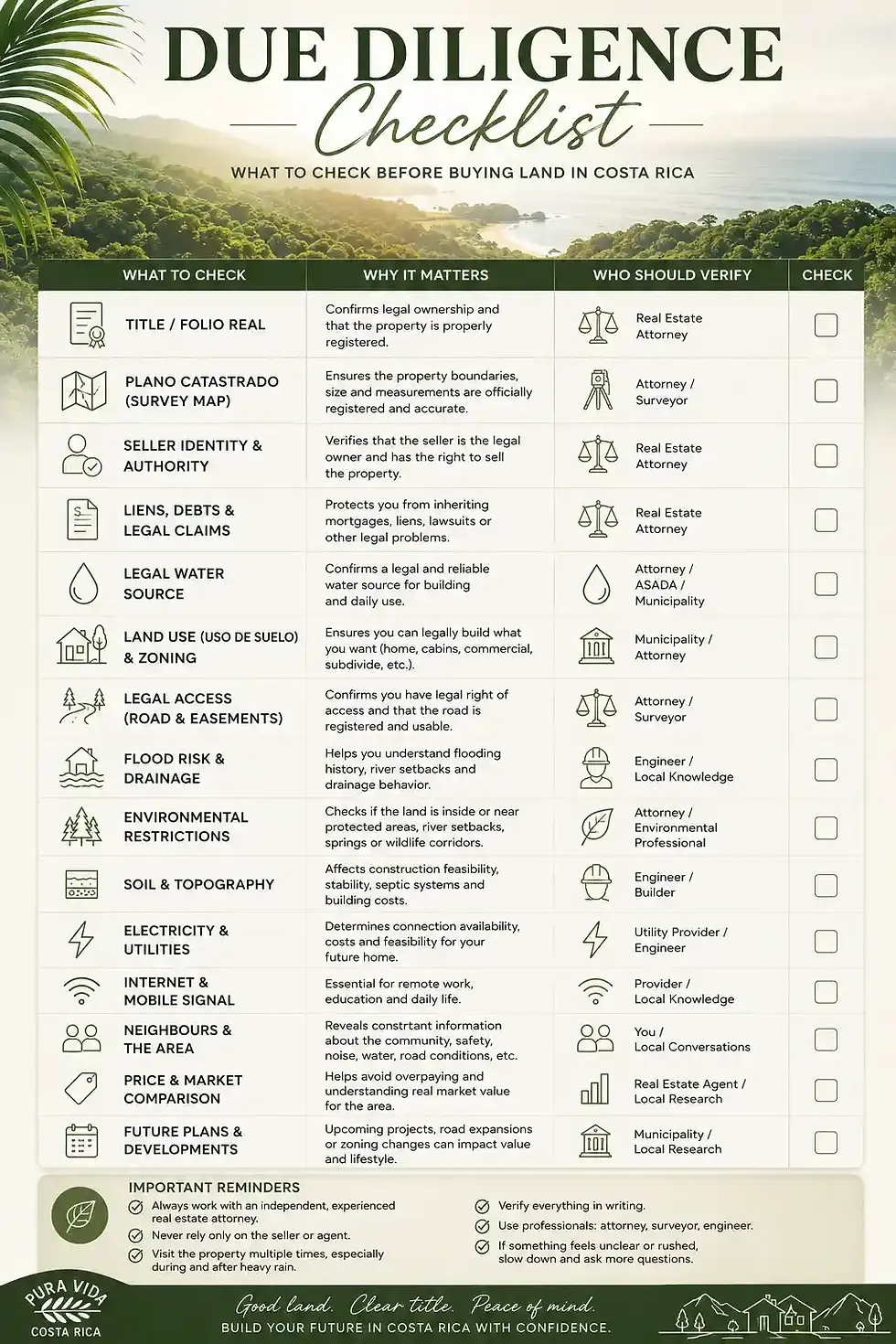
Due Diligence Checklist Before Buying Land
What to Check | Why It Matters | Who Should Verify It |
Title / Folio Real | Confirms legal ownership and registration | Real estate attorney |
Plano Catastrado | Confirms official survey and boundaries | Attorney / surveyor |
Seller Identity | Confirms the seller has legal authority to sell | Attorney |
Liens & Debts | Prevents inheriting legal or financial problems | Attorney |
Legal Water | Essential for building and daily life | Attorney / ASADA / municipality |
Land Use | Confirms what you can legally build | Municipality / attorney |
Access | Ensures you can legally and practically reach the property | Attorney / surveyor |
Flood Risk | Protects your home and investment | Neighbours / engineer / site visits |
Protected Areas | May limit or prohibit development | Attorney / environmental professional |
Soil & Drainage | Affects construction cost and safety | Engineer / builder |
Utilities | Determines cost and practicality of living there | Local providers |
Internet | Essential for remote work | Provider / neighbours / testing |
Neighbours | Helps you understand the real area | You |
Price Comparison | Helps avoid overpaying | Agent / local research |
Future Development | Affects privacy, access and long-term value | Municipality / local research |
Our Experience Finding Land
When we were searching for land, we did not rely on only one method.
We looked online.
We searched through Facebook.
We asked around locally.
We spoke to many people in the area.
Much of what we found was not right for us.
Some properties had unclear details.
Some were too expensive.
Some looked beautiful but had practical problems.
Some simply did not feel right.
But talking directly to people also had advantages.
You learn more about the region.
You understand local prices.
You hear stories that do not appear in listings.
You discover opportunities that may never be advertised publicly.
For us, finding the right land was not only about the property.
It was about the feeling of the place, the surrounding nature, the access, the future possibilities and the kind of life we imagined building there.
That journey eventually became Finca MiraVida.
Looking for Land Without Starting From Scratch?
After going through this process ourselves, we eventually created Finca MiraVida—a nature-focused neighbourhood where families can purchase private titled land while enjoying wonderful neighbours and shared values.
If you're looking for land but also value connection, children growing up together and a peaceful natural environment, you may enjoy learning more about our project.
How Finca MiraVida Fits Into This

Many families dream of buying land in Costa Rica, but they do not necessarily want to do it completely alone.
They want space and independence.
But they also want good neighbours.
They want their own land.
But they also want their children to grow up around other children.
They want freedom.
But not isolation.
That is the idea behind Finca MiraVida.
We are creating a nature-focused neighbourhood on Costa Rica’s Caribbean coast where families can own their own titled land, build their own homes and live independently—while being surrounded by people who share similar values.
It is not a commune.
It is not shared ownership.
It is not a traditional gated development.
It is a place for families who want their own land, their own home and wonderful neighbours nearby.
Private land.
Shared values.
Genuine connection.
For us, that is the balance many families are searching for.
Final Thoughts
Buying land in Costa Rica can be life-changing.
It can give your family space, freedom and the opportunity to create a home deeply connected to nature.
But it also requires patience, research and professional guidance.
Do not rush.
Do not buy only because a property looks beautiful.
Do not skip legal checks.
Do not ignore water, access, flooding or building restrictions.
The right land should not only inspire you.
It should also make sense legally, practically and financially.
When those things come together, buying land in Costa Rica can become much more than an investment.
It can become the beginning of a completely new chapter for your family.
Continue Your Costa Rica Journey
Buying land is only one step.
If you're planning a move, these guides may help you next:
🏥 Healthcare in Costa Rica (coming soon)
🌴 Daily Life in Costa Rica (coming soon)


Comments