Moving to Costa Rica with Family (Complete Guide 2026) | Costs, Schools, Land & Daily Life

Updated: Jul 7
The Ultimate Guide for Families Dreaming of a New Life in Costa Rica
Everything you need to know before relocating your family—from choosing the right region and finding schools to buying land, building a home and creating a slower, more intentional life surrounded by nature.
Last updated: 2026

Table of Contents
A Different Kind of Dream
Our Family's Story
What You Will Learn in This Guide
Why Costa Rica Has Become One of the World's Most Desired Family Destinations
11 Reasons Families Fall in Love with Costa Rica
Is Costa Rica Really Right for Everyone?
The Families Who Usually Thrive Here
Challenges Nobody Talks About
Questions You Should Ask Yourself Before Moving
Caribbean Coast
Pacific Coast
Central Valley
Southern Zone
Northern Region
Which Area Fits Your Lifestyle?
Housing
Food
Transportation
Healthcare
Schools
Monthly Budgets
Hidden Costs
Public Schools
Private Schools
International Schools
Homeschooling
Alternative Education
Our Experience
Public Healthcare (Caja)
Private Healthcare
Health Insurance
Finding Doctors
Emergency Care
Can Foreigners Buy Property?
How the Buying Process Works
Legal Steps
Water Rights
Building Restrictions
Common Mistakes
Construction Costs
Choosing Builders
Tropical Architecture
Off-Grid Options
Internet & Remote Work
Shopping
Driving
Weather
Wildlife
Raising Children
Community
More than 50 of the most common questions families ask before moving to Costa Rica.

Why This Guide Exists "Moving to Costa Rica with family"
If you're reading this, chances are you've already imagined a different kind of life.
Perhaps you've pictured your children growing up surrounded by nature instead of traffic.
Maybe you've dreamed of warm weather year-round, a slower pace of life and more meaningful time together as a family.
Or perhaps you're simply wondering whether moving to Costa Rica could actually become your reality.
This guide was written for families exactly like yours
More Than a Move
Some dreams begin quietly.
Not with a dramatic decision or a one-way plane ticket, but with a simple thought that keeps returning.
"What if life could be different?"
Maybe you've asked yourself that question.
Perhaps it came while sitting in traffic after another long workday.
Maybe while watching your children spend more time indoors than outside.
Or perhaps while wondering if life has gradually become more about schedules, obligations and deadlines than about actually living.
For many families, the idea of moving to Costa Rica doesn't begin with a desire to leave everything behind.
It begins with the hope of moving closer to something.
Closer to nature.
Closer to family.
Closer to a slower, healthier and more intentional way of life.
That is exactly how our own journey began.

Our Story
Several years ago, our family made a decision that many people considered unrealistic.
We left behind the familiar and started building a completely new life on Costa Rica's Caribbean coast.
Not because life elsewhere was terrible.
Not because we believed Costa Rica would be perfect.
But because we wanted something different for ourselves—and especially for our children.
We dreamed of a childhood filled with muddy feet, tree climbing, rivers, wildlife and endless curiosity.
A life where afternoons would be spent exploring nature instead of shopping malls.
Where family dinners wouldn't always be rushed.
Where success wouldn't be measured only by income, but also by time, freedom and meaningful experiences.
Of course, reality looked different from the dream.
Building a new life in another country comes with uncertainty.
There were moments of excitement.
Moments of frustration.
Moments where we questioned our decisions.
And countless moments where we realized we had absolutely made the right one.
Today our children wake up to the sounds of howler monkeys, hummingbirds and tropical rain instead of traffic.
They know the names of rainforest trees before they know many brand names.
Nature isn't something we visit on weekends.
It has become part of our everyday life.
And while we certainly don't believe Costa Rica is the right choice for every family, we do believe that many people deserve honest information before making such an important decision.
That is why this guide exists.
Why We Created This Guide
When we first started researching Costa Rica, we quickly discovered two extremes.
On one side were articles that made moving here sound effortless.
Everything seemed perfect.
No challenges.
No compromises.
Just beaches, palm trees and endless sunshine.
On the other side were stories focused almost entirely on bureaucracy, road conditions or cultural differences.
Neither reflected the complete picture.
The truth lies somewhere in between.
Costa Rica is one of the most extraordinary places we've ever experienced.
It is also a real country, with real challenges and real adjustments that every family should understand before making the move.
We believe families deserve balanced, practical and honest information—not marketing.
That is exactly what you'll find throughout this guide.
Whenever possible, we'll combine our own experiences with practical advice, research and lessons we've learned along the way.
What You'll Learn
Whether you're only beginning to dream or already planning your relocation, this guide will walk you through nearly every major question families ask before moving to Costa Rica.
Together we'll explore:
✔ Which part of Costa Rica might suit your family best.
✔ The real cost of living—including expenses many websites never mention.
✔ Schools, homeschooling and education options.
✔ Healthcare and insurance.
✔ Buying land safely.
✔ Building a home in the tropics.
✔ Wildlife, weather and everyday life.
✔ Common mistakes that can easily be avoided.
✔ How to decide whether Costa Rica truly matches your family's vision.
Along the way, we'll also share links to more detailed guides covering each topic in depth.
Our goal isn't to convince you to move here.
Our goal is to help you make the right decision for your own family.
Because moving to another country is about much more than changing your address.
It's about choosing the life you want to build together.
And sometimes, that decision changes everything.
Why Families Choose Costa Rica
Over the last decade, Costa Rica has quietly become one of the world's most desirable destinations for families looking to build a different kind of life.
Not because it's the cheapest country.
Not because it's perfect.
And certainly not because every day feels like a holiday.
Families move here for a much deeper reason.
They are searching for a lifestyle that feels more intentional.
A place where success isn't measured only by career achievements or bigger houses, but also by time spent together, meaningful experiences and a stronger connection with nature.
For many, Costa Rica represents something increasingly rare in today's world:
The opportunity to slow down.
To breathe.
To reconnect.
To build a life that feels aligned with their values.
Of course, every family has different reasons for making such a significant move.
Some are looking for year-round warm weather.
Others want more freedom for remote work.
Many dream of raising children closer to nature.
Some simply want to escape the constant rush of modern life.
Whatever your motivation, one thing becomes clear after spending time here:
Costa Rica offers far more than beautiful beaches.
It offers the possibility of creating a completely different rhythm of life.
Why Costa Rica Has Become One of the World's Most Desired Family Destinations
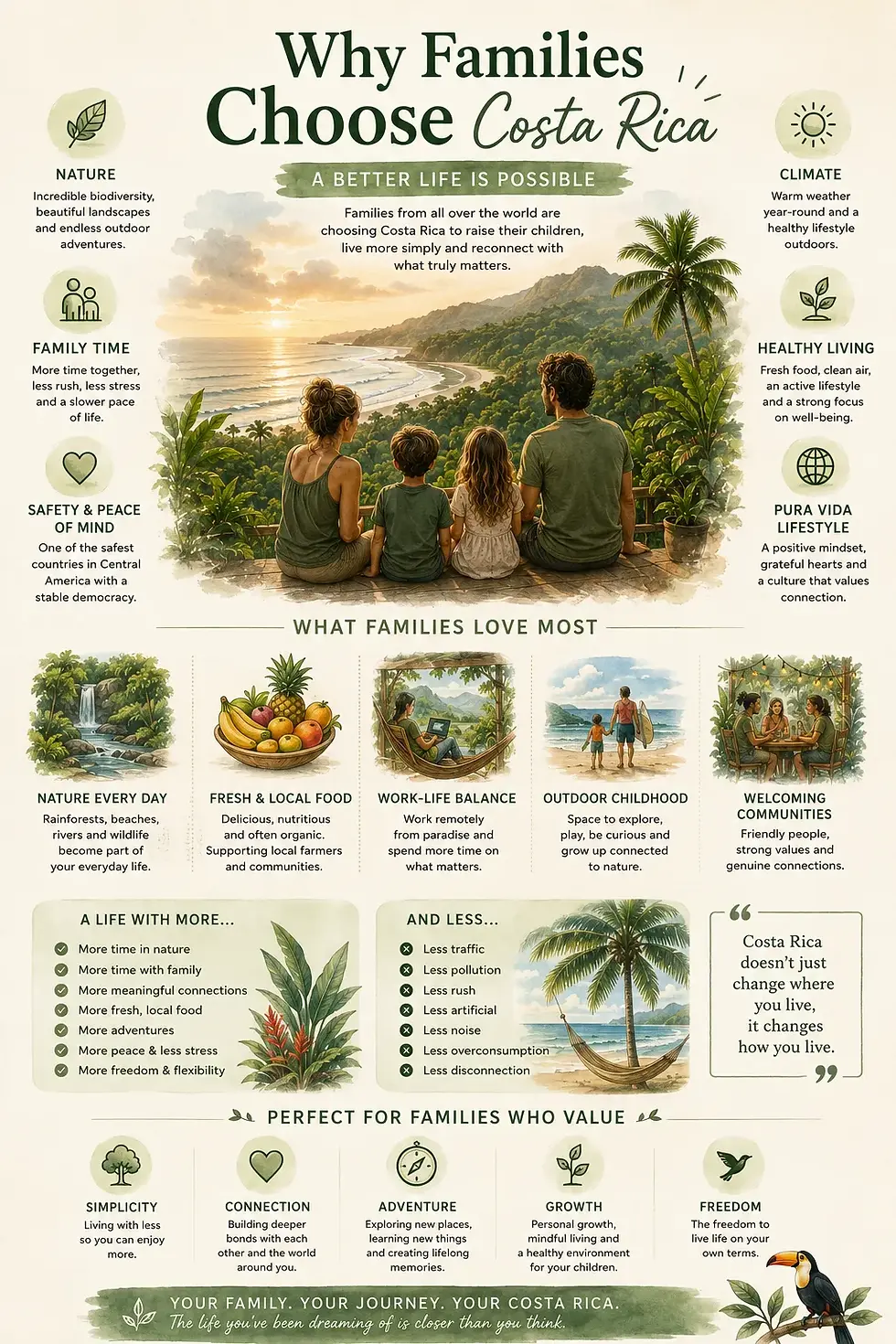
Unlike many countries that attract visitors primarily through tourism, Costa Rica has become increasingly popular among families who aren't looking for a holiday—they're looking for a home.
What makes Costa Rica different isn't just the scenery.
It's the combination of many small things that together create a unique quality of life.
Children still spend afternoons outside.
Fresh tropical fruit is available throughout the year.
Wildlife becomes part of everyday life rather than something you only see in documentaries.
Many communities remain welcoming, family-oriented and deeply connected to nature.
The country has also earned an international reputation for political stability, environmental protection and a strong commitment to preserving its extraordinary biodiversity.
For remote workers and entrepreneurs, reliable internet, growing digital infrastructure and an international community have made relocating easier than ever before.
At the same time, Costa Rica continues to attract people searching for something that is becoming increasingly difficult to find elsewhere:
A slower pace of life.
One where family dinners aren't constantly interrupted by schedules.
Where weekends don't always revolve around shopping centres.
Where children can still climb trees, explore rivers and come home covered in mud.
That lifestyle may not appeal to everyone.
But for many families, it feels like coming home.
Reason Families Choose Costa Rica | What It Means for Family Life | Best For Families Who Value |
Nature Everywhere | Rainforests, beaches, rivers, waterfalls and wildlife become part of everyday life, not just weekend trips. | Outdoor living, curiosity, adventure |
A Slower Pace of Life | Daily routines often feel less rushed, giving families more time to reconnect and be present. | Simplicity, calm, less stress |
Outdoor Childhood | Children have more opportunities to climb, explore, swim, observe animals and learn through real experiences. | Nature-based learning, freedom, movement |
Warm Climate Year-Round | Families can spend much more time outside throughout the year. | Sunshine, outdoor activities, tropical living |
Fresh Local Food | Farmers’ markets, tropical fruits and local produce make healthy eating easier and more enjoyable. | Health, fresh food, sustainability |
Family-Oriented Culture | Children are generally welcomed warmly, and family life is deeply valued in Costa Rican culture. | Connection, belonging, community |
Remote Work Possibilities | Reliable internet in many areas allows parents to combine online work with a more nature-based lifestyle. | Flexibility, location independence |
Political Stability | Costa Rica has long been known as one of the more stable countries in Central America. | Security, long-term planning |
Healthcare Options | Families can access both public and private healthcare depending on their needs and residency status. | Peace of mind, family wellbeing |
Pura Vida Mindset | The culture encourages gratitude, patience, simplicity and appreciation for everyday life. | Mindful living, emotional wellbeing |
A Different Definition of Success | Many families begin valuing time, freedom, health and shared experiences more than constant achievement or consumption. | Purpose, freedom, intentional living |
11 Reasons Families Fall in Love with Costa Rica
If you're still exploring whether Costa Rica could be the right destination for your family, we've created a dedicated guide covering the biggest reasons why so many people choose to move here.
In that article, we explore topics such as:
The incredible biodiversity.
The famous Pura Vida lifestyle.
Family-friendly culture.
Political stability.
Outdoor living.
Climate.
Healthcare.
Work-life balance.
And much more.
→ Read our complete article: 11 Reasons Why Costa Rica Continues to Attract Families From Around the World
It provides a broader introduction to the country, while this guide focuses specifically on what families need to know before making the move.
Is Costa Rica Really Right for Everyone?
Probably not.
And that's actually good news.
One of the biggest mistakes we see online is the idea that Costa Rica is somehow a perfect destination for everyone.
It isn't.
No country is.
Life here asks you to adapt.
The tropical climate is warm and humid.
Road conditions vary.
Bureaucracy can require patience.
Power outages occasionally happen.
You'll share your surroundings with insects, tropical rain and wildlife.
If your dream is to recreate exactly the same lifestyle you had back home—only with palm trees—you may end up feeling disappointed.
But if you're looking for something fundamentally different, Costa Rica can be an extraordinary place to build a life.
Families who thrive here often share similar values.
They enjoy spending time outdoors.
They value experiences over possessions.
They're comfortable with change.
They're curious about other cultures.
And they're willing to trade a little convenience for a lot more freedom.
Perhaps the most important lesson we've learned is this:
Don't move to Costa Rica because you're running away from your old life.
Move because you're excited about creating a new one.
That simple difference often determines whether families merely live in Costa Rica—or truly feel at home here.
How We're Bringing This Vision to Life
Reading about this lifestyle is one thing. Living it is something completely different. At MiraVida, we're creating a small neighbourhood for families who share similar values—nature, freedom, meaningful education and a slower pace of life. If you're curious about the project, we'd love to show you what we're building.

Is Costa Rica Right for Your Family?
Every family dreams of a better life.
But what "better" looks like is different for everyone.
For some, it's a bigger house.
For others, it's a higher income or a faster career.
And then there are families searching for something that can't easily be measured.
More time together.
More freedom.
More adventure.
More connection with nature.
If that's the kind of life you're dreaming about, Costa Rica may already be on your list.
But before you fall in love with tropical beaches and rainforest views, it's worth asking a more important question:
Is Costa Rica truly the right place for your family?
After talking to hundreds of people who dream of relocating, we've learned that the answer isn't always yes.
And that's perfectly okay.
Moving to another country isn't simply changing your address.
It's changing your routines, your expectations, your community, your culture and, in many ways, your entire lifestyle.
The families who arrive with realistic expectations usually discover something extraordinary.
Those expecting a permanent vacation often leave disappointed.
Costa Rica isn't paradise.
It's simply a beautiful country where everyday life still comes with everyday challenges.
The question isn't whether Costa Rica is perfect.
The question is whether it's the right fit for the life you want to build.

The Families Who Usually Thrive Here
Over the years we've noticed that the happiest families aren't necessarily the wealthiest, the most experienced travellers or those with the most detailed plans.
Instead, they often share a similar mindset.
They see change as an adventure rather than a problem.
They're curious.
Flexible.
Patient.
And willing to learn.
Families who thrive in Costa Rica usually enjoy spending time outdoors.
Instead of asking whether there's a shopping mall nearby, they're excited about discovering waterfalls, hiking through the rainforest or watching wildlife together.
They don't mind getting caught in a tropical rainstorm.
They understand that muddy shoes often mean unforgettable memories.
Many also discover that they gradually begin to value different things.
Children spend more time climbing trees than staring at screens.
Weekends become less about shopping and more about exploring.
Birthdays are celebrated on beaches, rivers or around campfires instead of crowded indoor venues.
Family dinners become slower.
Conversations become longer.
Life starts to feel less scheduled.
Perhaps the biggest shift happens in the definition of success.
Back home, success is often measured by bigger houses, nicer cars or promotions.
Here, many families begin measuring success differently.
Did we spend meaningful time together today?
Did our children laugh?
Did we experience something new?
Did we create memories instead of simply crossing tasks off a list?
Of course, everyone's priorities are different.
But for families seeking a slower, more intentional lifestyle, Costa Rica often offers exactly the environment they were searching for.
Challenges Nobody Talks About
Social media has a habit of showing only the beautiful moments.
Palm trees.
Sunsets.
Happy children on the beach.
Those moments absolutely exist.
But they aren't the whole story.
The reality of living in Costa Rica includes challenges that are rarely mentioned online.
The tropical climate is warm—and often very humid.
Mould can appear surprisingly quickly if homes aren't properly ventilated.
Heavy rain may last for days during certain parts of the year.
Road conditions vary significantly depending on where you live.
Some products you're used to buying may be difficult to find or considerably more expensive because they're imported.
Bureaucracy often requires patience.
Appointments don't always happen exactly on time.
Things generally move at a slower pace.
At first, this can feel frustrating.
Eventually, many families discover that this slower rhythm becomes one of the things they appreciate most.
Living in nature also means sharing it.
You'll encounter insects.
Geckos.
Ants.
Mosquitoes.
Occasionally snakes.
And countless other animals that were never part of daily life back home.
For some families, this is exciting.
For others, it takes time to adjust.
One challenge people rarely mention is missing family and lifelong friends.
No tropical beach can completely replace grandparents, childhood friends or familiar traditions.
Building a new support network takes time.
Like any meaningful life change, moving abroad brings moments of uncertainty alongside moments of incredible joy.
Understanding both sides before you move makes the transition much easier.
Questions You Should Ask Yourself Before Moving
Before searching for houses, schools or flights, spend some time asking yourselves a few honest questions.
Not because there are right or wrong answers—but because they can reveal whether your expectations truly match the lifestyle Costa Rica offers.
Why do we want to move?
Are you running away from stress, or moving toward a different vision for your family's future?
The distinction matters.
No country can solve problems that travel with you.
But a new environment can help you build a different life if you already know what you're looking for.
How important is nature in our daily lives?
Do you genuinely enjoy spending time outdoors, even when it rains?
Would your children be excited about rivers, forests and wildlife?
Or would they quickly miss shopping centres, theme parks and constant entertainment?
How flexible are we?
Life in Costa Rica often requires adapting.
Plans change.
Roads close.
Repairs take longer than expected.
The families who adapt rather than resist usually experience far less stress.
Are we prepared to simplify?
Many people discover they actually need far less than they once believed.
Instead of accumulating more possessions, they begin collecting experiences.
For many families, that shift becomes one of the greatest gifts of moving abroad.
Are we looking for a holiday—or a home?
Perhaps this is the most important question of all.
Holidays highlight the extraordinary moments.
Real life includes grocery shopping, school runs, rainy days, paperwork, maintenance and responsibilities.
Question to Ask Yourself | Costa Rica May Be a Good Fit If… | It May Be Challenging If… |
Do we enjoy spending time outdoors? | Your family loves nature, rivers, beaches, forests and outdoor adventures. | You prefer indoor entertainment, shopping malls and highly structured activities. |
Are we flexible when plans change? | You can adapt when things take longer, weather changes or systems work differently. | You get stressed when schedules, appointments or processes are unpredictable. |
Do we want a simpler lifestyle? | You value time, freedom, family connection and experiences more than possessions. | You strongly rely on convenience, fast delivery and access to every familiar product. |
How important is nature in our daily life? | You want your children to grow up surrounded by wildlife, plants, fresh air and natural spaces. | You feel uncomfortable with insects, humidity, rain, mud or living close to wildlife. |
Can we handle cultural differences? | You are curious, respectful and willing to learn from a different way of life. | You expect everything to work exactly as it does in your home country. |
Are we prepared for tropical weather? | You can enjoy both sunshine and rain and understand that humidity is part of life in many regions. | You dislike heat, rain, humidity or seasonal weather changes. |
Do we have realistic expectations? | You understand Costa Rica is a real country with beauty, challenges and everyday responsibilities. | You expect life to feel like a permanent vacation. |
Are we willing to learn Spanish? | You are open to learning the language and connecting with local people. | You want to live completely in an English-speaking bubble. |
Can we build a new community slowly? | You are patient and willing to meet people through neighbours, activities, schools or shared projects. | You expect instant friendships and a ready-made social circle immediately. |
Why do we really want to move? | You are moving toward a clear vision for your family’s future. | You are mainly trying to escape problems that may follow you anywhere. |
If you can still imagine yourselves building a meaningful life here after considering all of those everyday realities, then Costa Rica may deserve a place at the top of your family's list.
Because in the end, moving to Costa Rica isn't about escaping your old life.
It's about intentionally creating a new one.
And for the right family, that decision can become one of the most rewarding adventures they'll ever experience.
Imagine Living Among Like-Minded Families
Many families dream of moving to Costa Rica but don't necessarily want to do it alone. MiraVida was born from a simple idea: What if several families who share similar values could become neighbours—each on their own land, yet connected through friendship, nature and community?

Choosing the Right Region for moving to Costa Rica with family
One of the first questions every family asks after deciding to move to Costa Rica is surprisingly simple:
"Where should we live?"
Unfortunately, there isn't one perfect answer.
Costa Rica may look small on a map, but every region offers a completely different lifestyle.
Some areas are busy and highly developed.
Others feel wild, remote and deeply connected to nature.
Some receive less rainfall.
Others remain lush and green all year round.
Some are ideal for surfers.
Others attract digital nomads, retirees or families looking for a quieter pace of life.
Choosing the right location often has a much bigger impact on your happiness than choosing the right house.
The best region isn't necessarily the most popular one.
It's the place that matches your family's values, priorities and vision for the future.
Let's explore the main regions to help you discover which one feels most like home.

Caribbean Coast
If someone asked us where Costa Rica feels the most authentic, we'd probably answer: The Caribbean.
This is where our own family chose to build a life. The Caribbean coast is different from almost every other part of the country.
Life moves more slowly.
Communities tend to be smaller.
Nature feels incredibly close.
Rainforest, rivers and the ocean often exist within just a few kilometres of one another.
Instead of large resorts, you'll find colourful villages, local markets, hidden beaches and an atmosphere that encourages you to slow down.
Wildlife is part of everyday life.
Seeing sloths, toucans, hummingbirds, monkeys or butterflies becomes surprisingly normal.
For families who dream about raising children surrounded by nature, it's difficult to imagine a more inspiring environment.
The Caribbean isn't the right choice for everyone.
Rainfall is generally higher than on parts of the Pacific coast, and infrastructure is often more relaxed and less developed.
But for those seeking community, authenticity and a strong connection with nature, it offers something truly special.
Pacific Coast
The Pacific coast is probably the best-known region among international visitors.
It stretches for hundreds of kilometres and includes everything from lively surf towns and luxury resorts to peaceful fishing villages.
Infrastructure is generally more developed.
There are more restaurants, larger supermarkets and a wider range of services aimed at international residents.
Many families appreciate the variety of international schools, sports activities and established expat communities found in some Pacific towns.
If you enjoy an active lifestyle, surfing or having plenty of entertainment options nearby, the Pacific coast may be an excellent fit.
Because it's also one of Costa Rica's most popular tourist destinations, some areas can feel busier and more commercial than other parts of the country.
Central Valley
For families looking for convenience, the Central Valley is often the easiest place to settle.
Home to San José and several surrounding cities, this region offers many of the services people are familiar with from larger urban areas.
You'll find some of the country's best hospitals, universities, shopping centres and international schools here.
The climate is generally cooler than along the coasts thanks to the higher elevation, making it especially attractive for people who prefer milder temperatures.
The trade-off is a more urban lifestyle.
Traffic can be heavy, and daily life often feels faster than in Costa Rica's coastal regions.
For many families, however, the excellent infrastructure outweighs those disadvantages.
Southern Zone
Costa Rica's Southern Zone has become increasingly popular among people searching for space, privacy and spectacular natural beauty.
The region is known for its mountains, waterfalls, untouched beaches and impressive biodiversity.
Compared to more established tourist destinations, many parts of the Southern Zone remain relatively quiet.
It's an excellent choice for families interested in sustainable living, eco-projects or building a home surrounded by nature.
Because the region is less developed in places, everyday life may require a little more planning, but many residents consider that part of its charm.
Northern Region
The Northern Region offers a completely different side of Costa Rica.
Instead of beaches, you'll discover volcanoes, forests, rivers, farmland and natural hot springs.
The famous Arenal Volcano attracts visitors from around the world, but beyond the tourism hotspots you'll also find peaceful rural communities where agriculture and outdoor living remain central to daily life.
Families who enjoy hiking, wildlife, horseback riding and freshwater adventures often feel at home here.
The climate varies depending on elevation, creating a surprising diversity of landscapes within a relatively small area.

Which Area Fits Your Lifestyle?
There is no universally "best" place to live in Costa Rica.
There is only the place that best matches your family's lifestyle.
If you love surfing, restaurants and an active international community, the Pacific coast may feel like home.
If excellent healthcare, international schools and urban convenience are your priorities, the Central Valley could be your ideal choice.
If you're searching for privacy, large properties and sustainable living projects, the Southern Zone deserves serious consideration.
If volcanoes, forests and cooler temperatures excite you, the Northern Region may be the perfect fit.
And if your dream is to wake up surrounded by rainforest, hear monkeys in the morning, spend weekends exploring rivers and quiet beaches, and give your children a childhood deeply connected to nature, you'll probably fall in love with Costa Rica's Caribbean coast—just as we did.
Wherever you choose to settle, remember that you're not only choosing a location.
You're choosing the environment in which your family will build its new life.
Take your time.
Visit different regions.
Talk to local families.
Experience each place beyond the tourist attractions.
The right location won't simply impress you.
It will feel like somewhere you can truly belong.
What If This Is the Beginning of Your Story?
Every family arrives in Costa Rica with a different dream. Some are searching for adventure. Others want more time together. Some simply want a place where their children can grow up surrounded by nature. Our dream eventually became MiraVida. Perhaps yours is only just beginning. If our vision resonates with you, we'd love to hear your story.

The Real Cost of Living in Costa Rica
One of the first questions nearly every family asks before moving is:
"Can we actually afford to live in Costa Rica?"
The answer is both simple and surprisingly complex.
It depends.
Unlike many countries, the cost of living in Costa Rica isn't defined by one average number.
Two families living only thirty minutes apart can have completely different monthly expenses.
One may enjoy a simple, nature-based lifestyle on a rural property.
Another may live in a luxury gated community with private schools, imported groceries and frequent restaurant visits.
Both are living in Costa Rica.
Both are perfectly happy.
Yet their monthly budgets may differ by several thousand dollars.
Rather than asking "How expensive is Costa Rica?", it's often more helpful to ask:
"What kind of life do we want to build?"
The answer to that question usually determines your budget far more than the country itself.
For a detailed breakdown of real costs, we've created a dedicated guide:
→ Read our complete article: The Real Cost of Living in Costa Rica — What Future MiraVida Families Should Know
Below you'll find a general overview of the biggest expenses most families should plan for.
Housing
Housing will almost always be your largest monthly expense.
Rental prices vary enormously depending on location, size and distance from the beach.
A simple home in a rural area may cost only a fraction of a modern house in one of Costa Rica's more popular coastal towns.
Many families begin by renting for six to twelve months before deciding where they truly want to settle.
It's one of the best decisions you can make.
Living somewhere is very different from spending two weeks there on holiday.
Taking your time allows you to understand neighbourhoods, weather patterns, traffic, schools and local communities before making a long-term commitment.
Food
One of the biggest surprises for many newcomers is that food can be both cheaper and more expensive than expected.
Fresh tropical fruit, vegetables and locally produced goods are often very affordable.
Shopping at farmers' markets can significantly reduce grocery bills while providing fresher produce than many supermarkets.
Imported products, however, are another story.
International brands, specialty foods and familiar products from Europe or North America often carry considerably higher prices.
Many families naturally adapt over time.
Instead of trying to recreate the exact shopping habits they had back home, they begin enjoying seasonal local produce and discover an entirely different way of eating.
Transportation
Transportation costs depend largely on where you decide to live.
Families living in more rural areas usually find having a car almost essential.
In larger towns and cities, public buses provide an affordable alternative for many everyday journeys.
Fuel prices are generally higher than in North America, while vehicle prices can also be noticeably more expensive due to import taxes.
Before buying a vehicle, many new residents spend several months learning how often they actually need one.
Healthcare
Healthcare is often one of the biggest concerns for families considering an international move.
Fortunately, Costa Rica has built an excellent reputation for both public and private healthcare.
Many residents combine the public healthcare system with private clinics for faster appointments when needed.
Compared with many other countries, healthcare remains surprisingly affordable while maintaining a high standard of care.
We'll explore this topic in much greater detail later in this guide.
Schools
Education costs vary depending on the type of school your family chooses.
Costa Rica offers public schools, bilingual schools, private schools and several international schools.
Each comes with different tuition fees, educational philosophies and language options.
For many families, choosing the right school becomes one of the most important financial—and personal—decisions they make.
If you're interested in learning more about our own experience, you can also read:
Monthly Budgets
Every family's budget looks different.
The examples below are intended only as general guidance.
Lifestyle | Estimated Monthly Budget |
Couple living simply | $1,800–2,500 |
Family of four (comfortable lifestyle) | $3,000–5,000 |
Family with private international schools | $5,500–8,000+ |
These figures naturally vary depending on housing, transportation, schooling and personal lifestyle choices.
The encouraging news is that Costa Rica offers enough flexibility for many different budgets.
Some families choose simplicity.
Others enjoy a more luxurious lifestyle.
Both approaches are entirely possible.

Hidden Costs
When planning your move, don't focus only on rent and groceries.
There are several expenses that many people overlook during the planning stage.
These may include:
Residency applications and legal fees
Import taxes on vehicles
Furniture and household items
Internet installation
Home maintenance in a tropical climate
Air conditioning or dehumidifiers in some regions
Pet relocation
Travel back to visit family and friends
Unexpected repairs
Currency exchange fluctuations
Building a small emergency fund before moving can make the transition much less stressful.
Like every international relocation, there will always be unexpected expenses.
The good news is that most families quickly discover something equally unexpected.
As life becomes simpler, many everyday expenses also become simpler.
Instead of constantly spending money on entertainment, shopping or weekend activities, many of the best experiences in Costa Rica cost very little.
A walk through the rainforest.
An afternoon at the beach.
A swim in a river.
A sunset shared with the people you love.
Sometimes, the richest moments don't appear anywhere in your monthly budget.

Schools & Education
For many parents, education becomes the single biggest question after deciding to move to Costa Rica.
Where will our children go to school?
Will they learn Spanish?
Should we choose a public school or an international school?
Is homeschooling possible?
Will they make friends?
These questions are completely normal.
After all, moving to another country doesn't only change your own life—it changes your children's world as well.
The good news is that Costa Rica offers far more educational options than many people expect.
There isn't one "correct" choice.
The best school depends on your child's personality, your family's values, your budget and the lifestyle you're hoping to create.
Let's explore the most common options.
Public Schools
Costa Rica's public education system is available throughout the country and provides children with a valuable opportunity to fully immerse themselves in the local culture and language.
Lessons are taught primarily in Spanish, making public schools an excellent option for families who want their children to integrate quickly into Costa Rican life.
As with every country, the quality of schools varies depending on the region and the individual school.
Many families appreciate the cultural experience, while others feel their children would benefit from smaller class sizes or bilingual education.
Visiting several schools before making a decision is always worthwhile.
Private Schools
Private schools are a popular choice among both Costa Rican and international families.
They often offer smaller class sizes, additional extracurricular activities and more individual support for students.
Many private schools also place a stronger emphasis on English alongside Spanish, creating a bilingual learning environment from an early age.
Tuition fees vary considerably depending on the school, location and educational philosophy.
Some focus primarily on academics, while others place equal importance on creativity, personal development and outdoor learning.
International Schools
Families planning to relocate long-term often consider international schools, particularly if they expect their children to continue their education in another country later on.
International schools usually teach in English and may follow internationally recognised curricula such as the International Baccalaureate (IB), American or British educational systems.
These schools often provide excellent facilities and a multicultural environment where children from many different countries learn together.
The main consideration is cost, as international schools are generally the most expensive educational option in Costa Rica.

Homeschooling
An increasing number of international families are exploring homeschooling after moving to Costa Rica.
Some choose it because they travel frequently.
Others appreciate the flexibility it offers.
And many simply want to create a learning experience that reflects their family's values and their children's individual interests.
Nature itself becomes an extraordinary classroom.
Rainforests become biology lessons.
Farmers' markets become mathematics.
Rivers become science experiments.
Daily life offers opportunities for practical, hands-on learning that are difficult to recreate inside traditional classrooms.
If homeschooling interests your family, it's important to research the legal and practical considerations based on your nationality, residency status and long-term educational goals.
Alternative Education
Costa Rica has also become home to a growing number of alternative educational approaches.
Forest schools, Montessori-inspired programmes, democratic schools and project-based learning communities are becoming increasingly popular among families seeking a different educational experience.
These schools often encourage curiosity, creativity, independence and outdoor exploration rather than focusing exclusively on traditional classroom instruction.
For many families moving to Costa Rica specifically because they want a different lifestyle, these educational philosophies feel like a natural extension of the life they're trying to build.

Our Experience
When we first started searching for schools, we quickly realised that choosing a school wasn't simply about academics.
It was about finding an environment where our children would feel safe, curious and genuinely excited to learn.
Like many parents, we visited different schools, asked countless questions and spent a lot of time thinking about what truly mattered to our family.
Eventually, we found a school that felt aligned with our values.
Rather than choosing the biggest or most well-known option, we chose the environment that we believed would help our children grow—not only academically, but also emotionally and socially.
Every family will make a different decision.
What matters most is finding the place where your own child can thrive.
If you'd like to learn more about our journey and why we chose our children's school on Costa Rica's Caribbean coast, we've shared our complete experience here:
One lesson we've learned is that there is no perfect school.
There is only the school that best matches your family's values, your child's personality and the life you're hoping to build together.
Option | Language | Cost | Best For | Social Integration | Flexibility |
Public School | Spanish | ⭐ | Full cultural immersion | ⭐⭐⭐⭐⭐ | ⭐ |
Private School | Spanish + English | ⭐⭐–⭐⭐⭐ | Balanced education | ⭐⭐⭐⭐ | ⭐⭐ |
International School | Mostly English | ⭐⭐⭐⭐ | International curriculum | ⭐⭐⭐ | ⭐⭐ |
Homeschooling | Flexible | ⭐–⭐⭐ | Independent families | ⭐⭐ (depends on activities) | ⭐⭐⭐⭐⭐ |
Alternative Education | Varies | ⭐⭐–⭐⭐⭐ | Nature & project-based learning | ⭐⭐⭐⭐ | ⭐⭐⭐⭐ |
Our Vision for Education
One of the reasons we're creating MiraVida is because we believe learning doesn't only happen inside classrooms. Our long-term vision is to create opportunities where children can learn through nature, projects and real-life experiences while families support one another.

Healthcare in Costa Rica
For many families, healthcare is one of the biggest concerns when considering an international move.
It's completely understandable.
Knowing that you and your children will have access to good medical care brings peace of mind—and for many people, it can even influence where they decide to live.
The good news is that Costa Rica has earned an excellent international reputation for its healthcare system.
Many expatriates are pleasantly surprised by both the quality of care and the professionalism of doctors throughout the country.
Like many Costa Ricans, international residents often combine the strengths of the public healthcare system with the flexibility of private clinics.
Understanding how both systems work will help you decide which approach best fits your family's needs.
Public Healthcare (Caja)
Costa Rica's public healthcare system, commonly known as Caja (Caja Costarricense de Seguro Social), provides medical care to residents across the country.
Once you're eligible and enrolled, the system gives access to a wide range of healthcare services, including family doctors, specialists, hospitals and emergency care.
Many expatriates appreciate the comprehensive coverage that Caja provides.
The trade-off is that waiting times for non-urgent appointments or specialist consultations can sometimes be longer than in the private system.
For routine healthcare and long-term medical needs, many families find Caja to be an excellent foundation.
Private Healthcare
Private healthcare is widely available throughout Costa Rica and is especially popular among expatriates.
Private clinics generally offer shorter waiting times, flexible appointment scheduling and often English-speaking doctors in areas with larger international communities.
Many families choose private healthcare for children's appointments, specialist consultations or situations where faster access is preferred.
Compared with many countries in North America, private healthcare costs in Costa Rica are often considered surprisingly reasonable.
As always, prices vary depending on the clinic, treatment and location.
Health Insurance
Health insurance is an important part of planning your move.
Some families rely primarily on Caja after obtaining residency.
Others choose private health insurance for additional flexibility or international coverage.
Some combine both approaches.
The right choice depends on factors such as your residency status, budget, existing medical conditions and how frequently you expect to use private healthcare services.
Before relocating, it's worth comparing different insurance options and understanding exactly what each policy covers.
Finding Doctors
Finding the right doctor is often easier than many people expect.
In larger towns and cities, you'll find experienced general practitioners, paediatricians, dentists and medical specialists.
Many doctors have completed part of their medical training abroad and speak fluent English, particularly in regions with international communities.
As with choosing schools or neighbourhoods, recommendations from local families and long-term residents are often one of the best ways to find trusted healthcare providers.
Building relationships with local doctors early can make future healthcare much less stressful.
Emergency Care
No family wants to think about medical emergencies—but it's reassuring to know what to expect.
Costa Rica has hospitals and emergency services throughout the country, although response times and access naturally vary depending on how remote your location is.
Families living in more rural areas often familiarise themselves with the nearest hospitals, emergency clinics and ambulance services shortly after arriving.
Fortunately, serious emergencies are relatively uncommon.
Like anywhere else, being prepared simply provides additional peace of mind.
Keeping important phone numbers, insurance information and the location of your nearest medical facilities readily available is always a good idea.

Our Experience
One thing we've learned since moving to Costa Rica is that healthcare quickly became something we worried about far less than we expected.
Whether it was routine check-ups, children's appointments or unexpected situations, we've consistently found caring professionals and a healthcare system that gave us confidence.
Of course, every family's experience will be different, and your choice between public and private healthcare will depend on your individual needs.
But if access to quality healthcare is one of the reasons you're hesitating about moving to Costa Rica, we hope this chapter reassures you that excellent medical care is available throughout much of the country.
As with many aspects of life here, a little preparation goes a long way.
Public (Caja) | Private Healthcare | |
Cost | ⭐ | ⭐⭐⭐ |
Waiting Times | ⭐⭐ | ⭐⭐⭐⭐⭐ |
English-speaking Doctors | ⭐⭐⭐ | ⭐⭐⭐⭐⭐ |
Specialists | ⭐⭐⭐ | ⭐⭐⭐⭐⭐ |
Emergency Care | ⭐⭐⭐⭐ | ⭐⭐⭐⭐ |
Best For | Residents | Faster appointments & flexibility |

Buying Land in Costa Rica
For many families, there comes a moment when the dream begins to feel real.
It usually isn't when they book their flights.
Or when they start learning Spanish.
It's when they begin looking at land.
Suddenly, the idea of "one day" becomes a real possibility.
A place where children might grow up.
A home that doesn't exist yet—but already feels imaginable.
A future that slowly begins taking shape.
Buying land in Costa Rica can be one of the most exciting parts of your journey.
It can also be one of the most important financial decisions you'll ever make.
Fortunately, purchasing property here is often much more straightforward than many people expect—provided you understand the process and work with the right professionals.
Below is a general overview of what every future landowner should know before making such an important decision.
We'll explore every step in much greater detail in our dedicated land-buying guide.
Can Foreigners Buy Property?

One of the questions we hear most often is refreshingly simple:
"Can foreigners actually own land in Costa Rica?"
In most cases, the answer is yes.
Costa Rica is well known for offering foreign buyers property rights that are generally comparable to those of Costa Rican citizens.
That has made the country one of Latin America's most attractive destinations for international buyers looking to relocate, retire or invest.
There are a few important exceptions, particularly regarding certain concession properties located within parts of the Maritime Zone along the coastline.
This is one of the reasons why proper legal advice is always essential before purchasing any property.
For the vast majority of titled land throughout the country, however, foreign ownership is both common and well established.
How the Buying Process Works
Buying land in Costa Rica follows a clear legal process, but every property is unique.
In general, the process includes:
Finding the right property.
Verifying ownership and title.
Reviewing legal documentation.
Confirming water availability.
Checking land-use regulations.
Signing the purchase agreement.
Completing the transfer through a Costa Rican notary.
Although the process is generally straightforward, every step deserves careful attention.
Rushing into a purchase simply because a property looks beautiful can become an expensive mistake later.
Take your time.
Visit the land more than once.
Walk the property.
Talk to neighbours.
Experience the area during different weather conditions.
The land you choose will shape your family's daily life for many years to come.
Legal Steps
One of the smartest investments you can make isn't the land itself.
It's hiring an experienced Costa Rican real estate attorney.
Before purchasing any property, your lawyer should verify important details such as:
Ownership records.
Property title.
Existing liens or debts.
Registered property boundaries.
Easements or rights of way.
Municipal regulations.
These legal checks help ensure that the property you're purchasing truly matches what you're expecting.
Fortunately, Costa Rica has a well-established legal framework for real estate transactions.
Working with qualified professionals significantly reduces unnecessary risks.

Water Rights
Beautiful views are wonderful.
Reliable water is essential.
One of the biggest mistakes new buyers make is focusing entirely on scenery while overlooking one of the most important practical questions:
Where will the water come from?
Depending on the location, water may be supplied through a public utility, a registered community water association (ASADA), a legal well or another approved source.
Water availability should always be confirmed before purchasing land—especially in more rural areas.
Never assume that because neighbouring properties have water, every property does as well.
This is one of the first questions experienced buyers ask.
And for good reason.
Building Restrictions
Every property comes with its own possibilities—and its own limitations.
Before buying land, it's important to understand what can actually be built there.
Depending on the location, regulations may affect:
Building coverage.
Environmental protection zones.
River setbacks.
Tree protection.
Access roads.
Utility connections.
Construction permits.
Understanding these rules early prevents costly surprises later.
Especially if you're planning to build your dream home, eco-lodge or family project, researching local regulations should be part of your decision-making process from the very beginning.
Common Mistakes
Buying land is exciting.
Sometimes a little too exciting.
Over the years we've noticed that many first-time buyers make similar mistakes.
They fall in love with a view before checking the paperwork.
They visit only during the dry season.
They underestimate travel times.
They don't ask enough questions about water, road access or future development nearby.
Or they buy too quickly because they're afraid someone else will purchase the property first.
Our biggest piece of advice?
Slow down.
The right property is worth waiting for.
Visit several regions.
Compare different lifestyles.
Imagine your daily routine—not just your weekends.
The goal isn't simply to buy land.
The goal is to choose the place where your family will build its future.
And that's a decision worth making carefully.
Question | Always Check Before Buying |
Title | ✅ |
Water | ✅ |
Road Access | ✅ |
Electricity | ✅ |
Building Restrictions | ✅ |
Flood Risk | ✅ |
Internet | ✅ |
Neighbours | ✅ |
Learn More
Buying land in Costa Rica is a fascinating process, and every property comes with its own opportunities and considerations.
Because this topic deserves much more than a single chapter, we've created a detailed guide covering every step—from finding the right property to legal due diligence, water rights, construction planning and avoiding expensive mistakes.
Read our complete guide: Buying Land in Costa Rica – Everything You Need to Know Before You Buy
Imagine Living Among Like-Minded Families
Many families dream of moving to Costa Rica but don't necessarily want to do it alone. MiraVida was born from a simple idea: What if several families who share similar values could become neighbours—each on their own land, yet connected through friendship, nature and community?

Building Your Dream Home in Costa Rica
For many families, buying land is only the beginning.
The real dream starts when you imagine the home you'll one day build on it.
A place designed around your family's lifestyle.
Large windows opening onto the rainforest.
A covered terrace where everyone gathers for dinner.
Children running barefoot through the garden.
Perhaps a small vegetable patch.
Fruit trees.
A hammock beneath the palms.
Building your own home in Costa Rica offers an incredible opportunity to create something that simply wouldn't be possible in many other parts of the world.
At the same time, building in the tropics is different.
The climate, materials, regulations and construction methods all require a different way of thinking.
Understanding these differences before you begin will save time, money and unnecessary stress.
Construction Costs
One of the first questions everyone asks is:
"How much does it cost to build a house in Costa Rica?"
The honest answer is that there is no single number.
Construction costs vary depending on:
The location.
The size of the home.
Building materials.
Architectural complexity.
Site preparation.
Accessibility.
Interior finishes.
A simple, functional family home will naturally cost far less than a luxury villa with custom finishes and premium materials.
Many families are surprised to discover that careful planning often has a greater impact on the final budget than choosing the cheapest builder.
Designing a home that works with the tropical climate instead of against it can also reduce long-term maintenance and energy costs.
Choosing Builders
Finding the right builder is just as important as finding the right piece of land.
A beautiful design means very little if the construction quality isn't there.
Take time to meet several builders.
Visit completed projects.
Speak with previous clients whenever possible.
Ask detailed questions about timelines, communication, warranties and the building process.
Good builders are usually happy to explain how they work and provide references.
Like any major investment, trust should be earned—not assumed.
A little extra research before construction begins can prevent significant problems later.
Tropical Architecture
One of the biggest mistakes people make is designing a house that would work perfectly in Europe or North America—but not in Costa Rica.
Tropical architecture isn't simply about appearance.
It's about comfort.
Homes here should be designed to work with the environment rather than fighting against it.
Good ventilation, generous roof overhangs, shaded outdoor living spaces and natural airflow often make a much bigger difference than expensive air conditioning systems.
Choosing durable materials that perform well in heat, humidity and heavy rainfall is equally important.
Many of the most beautiful homes in Costa Rica are surprisingly simple.
They blur the boundary between indoor and outdoor living, allowing nature to become part of everyday life.
Off-Grid Options
One of the reasons many families are drawn to Costa Rica is the possibility of living more independently.
Depending on your location, off-grid living can be a realistic option.
Solar energy has become increasingly common.
Rainwater harvesting, battery storage and sustainable building techniques allow many homes to operate with remarkable efficiency.
Some families choose to live completely off-grid.
Others prefer a hybrid approach that combines public utilities with renewable energy.
Neither option is inherently better.
The right solution depends on your property, your budget and the lifestyle you want to create.
For many people, off-grid living isn't about disconnecting from the modern world.
It's about becoming a little more connected to nature.
A little more self-sufficient.
And a little less dependent on systems outside your control.
Building It Yourself
One option that's often overlooked is becoming much more involved in the construction process yourself.
If you have experience in construction—or you're willing to learn and spend time on-site—building your own home can significantly reduce costs while giving you complete control over quality and every design decision.
This is the approach we've chosen for our own project.
Rather than handing everything over to a construction company, we're managing much of the process ourselves, carefully selecting materials, working with local professionals where needed and taking the time to create a home that truly reflects the lifestyle we want.
Of course, this approach isn't for everyone.
It requires time, organisation and a willingness to solve unexpected challenges.
But if you have the skills—or simply the motivation to be actively involved—it can be one of the most rewarding ways to build in Costa Rica.
Beyond the financial savings, there's something incredibly special about watching your family's future home take shape through your own effort.
Years from now, every room will carry a story.
💡 Our Experience
If you ask us whether we'd build ourselves again, our answer would be yes. It's certainly not the easiest path—but for us it offers the greatest freedom to create exactly the home we imagine, while keeping costs under control and learning valuable skills along the way.
Prefabricated Homes
For families looking for a faster and often more predictable building process, prefabricated homes have become an increasingly popular option in Costa Rica.
Modern prefab homes are very different from what many people imagine.
Today, many companies offer beautiful, architect-designed homes built to a high standard, with contemporary designs that fit perfectly into Costa Rica's tropical environment.
Depending on the company and level of customisation, prefabricated homes can offer several advantages:
Faster construction times
More predictable budgets
Factory-controlled quality
Less waste during construction
Modern energy-efficient designs
That said, not all prefab companies are the same.
The quality of materials, insulation, finishes and after-sales service can vary considerably.
As with any major investment, it's worth visiting completed projects, speaking with previous clients and carefully comparing different manufacturers before making a decision.
For some families, a custom-built home will always be the dream.
For others, a well-designed prefab home offers an excellent balance between quality, speed and affordability.
The best choice depends on your budget, timeline and the vision you have for your future home.
Our Advice
If there's one piece of advice we'd give every family before building in Costa Rica, it's this:
Don't rush.
Spend time living here first.
Experience both the dry season and the rainy season.
Notice how the sun moves across your property.
Watch where the wind comes from.
Learn how you naturally use outdoor spaces.
Your dream home shouldn't simply look beautiful in photographs.
It should make everyday life easier, more comfortable and more connected to the place you've chosen to call home.
Because ultimately, you're not just building a house.
You're building the setting for thousands of future family memories.
And that's worth planning carefully.
Building Option | Cost | Build Speed | Involvement | Customization | Best For |
Turnkey Construction Company | ⭐⭐⭐⭐ | ⭐⭐⭐⭐⭐ | ⭐ | ⭐⭐⭐ | Ideal for families who want a stress-free, fully managed building process. Usually the most expensive option, but also the most convenient. |
Owner-Managed Construction | ⭐⭐ | ⭐⭐ | ⭐⭐⭐⭐⭐ | ⭐⭐⭐⭐⭐ | Our preferred approach. By managing the project yourself and working directly with local professionals, you can often reduce costs while maintaining full control over quality and every design decision. |
Prefabricated Home | ⭐⭐⭐ | ⭐⭐⭐⭐⭐ | ⭐⭐ | ⭐⭐⭐ | Perfect for families looking for a faster, more predictable building process. Modern prefab homes can offer excellent quality, beautiful designs and surprisingly efficient construction times. |
Hybrid Build (Builder + Owner Management) | ⭐⭐⭐ | ⭐⭐⭐ | ⭐⭐⭐ | ⭐⭐⭐⭐ | A practical balance between convenience and control. Many families hire professionals for specialised work while managing parts of the project themselves. |
💡 MiraVida Tip
There is no single "best" way to build in Costa Rica. The right approach depends on your budget, available time, construction experience and how involved you want to be. Some families value convenience above all else. Others enjoy being part of every stage of the journey. Choose the option that best matches your lifestyle—not someone else's.

Learn More
Building in Costa Rica is a fascinating journey with countless decisions along the way.
Because this topic deserves its own comprehensive guide, we've created a detailed article covering construction costs, planning, choosing builders, permits, tropical design principles, off-grid systems and common mistakes.
→ Read our complete guide: Building a Home in Costa Rica – Everything You Need to Know Before You Start
Our Own Building Journey
We're currently building our own home using an owner-managed approach and documenting everything we learn along the way.
→ Follow Our Building Journey

Daily Life in Costa Rica
Long before families decide to move to Costa Rica, they usually imagine the big moments.
Buying land.
Building a home.
Watching their children run barefoot through nature.
But once you've settled here, life isn't made up of those extraordinary moments alone.
It's built from ordinary days.
Morning coffee on the terrace.
Children beginning another day of learning and discovery.
Shopping for fresh fruit.
Listening to tropical rain on the roof.
Weekend adventures in the rainforest.
Daily life is where Costa Rica truly begins to feel like home.
While every family's journey is different, many newcomers discover that the greatest changes aren't the ones they expected.
They aren't simply living in a different country.
They're living differently.

Internet & Remote Work
One of the biggest misconceptions about Costa Rica is that reliable internet is difficult to find.
Years ago, that may have been true in some areas.
Today, many parts of the country offer excellent internet connections, making Costa Rica an increasingly popular destination for remote workers, entrepreneurs and online business owners.
In more rural locations, services such as Starlink have made it possible to work from places that would once have seemed impossible.
Many families create a rhythm that allows work and family life to exist side by side.
Instead of spending hours commuting, parents often gain something far more valuable:
Time.
Time for breakfast together.
Time for nature.
Time for the little moments that are so easily lost in a busy lifestyle.
Of course, internet quality still depends on where you choose to live.
If working online is essential for your family, always verify available providers before choosing a property.
Fortunately, combining tropical living with a successful remote career is becoming easier every year.
Shopping
Shopping in Costa Rica is a little different from what many people are used to.
Large supermarkets exist, especially around cities and tourist areas.
But many families quickly discover that some of the best shopping happens elsewhere.
Weekly farmers' markets are full of fresh fruit, vegetables, local cheese, homemade bread and seasonal produce.
Instead of shopping for imported brands, many people gradually begin eating more local food.
Some familiar products may be harder to find—or more expensive.
In return, you'll discover fruits you've never tasted before and ingredients that naturally become part of your family's everyday meals.
Shopping slowly becomes less about convenience and more about quality.
Driving
Driving in Costa Rica is an adventure of its own.
Some roads are modern and well maintained.
Others can be narrow, winding or unpaved—especially in more rural areas.
Travel times often look short on a map but can take longer than expected due to road conditions and mountain terrain.
Many families eventually stop measuring distance in kilometres and begin measuring it in experiences.
The journey itself often becomes part of the adventure.
Owning a reliable vehicle becomes especially valuable if you choose to live outside larger towns.
Weather
Costa Rica's climate is one of the country's greatest attractions.
Warm temperatures throughout the year encourage a lifestyle centred around the outdoors.
Instead of four traditional seasons, most regions experience a dry season and a rainy season.
Rain isn't something to fear.
In fact, many residents come to love it.
Tropical showers often arrive dramatically, cool the air and leave the rainforest feeling even more alive.
Life here isn't planned around avoiding the weather.
It's about learning to enjoy every part of it.

Wildlife
One of the greatest gifts of living in Costa Rica is that nature isn't something you visit.
It's something you live with.
Monkeys may wake you in the morning.
Sloths become familiar neighbours.
Toucan sightings can brighten an ordinary afternoon.
Butterflies, hummingbirds, frogs and countless tropical birds become part of everyday life.
Of course, wildlife also means learning to respect the environment.
Occasionally you'll encounter snakes, insects or other animals that deserve both caution and appreciation.
For many children, growing up surrounded by this biodiversity becomes one of the greatest gifts of their childhood.
Raising Children
Perhaps this is the reason so many families dream about moving to Costa Rica.
Childhood often looks different here.
Children spend more time outdoors.
They climb trees.
Play in rivers.
Build forts.
Care for animals.
Grow vegetables.
Learn through curiosity.
Whether children attend a local school, an international school, learn through homeschooling or follow alternative educational paths, Costa Rica offers something many families feel has become increasingly rare:
Space to explore.
Time to be curious.
And a childhood deeply connected to nature.
Parents often discover something unexpected as well.
Life slows down enough to simply enjoy being together.
Meals become longer.
Conversations become richer.
Adventures become part of everyday life rather than something reserved for holidays.
Community
Moving abroad naturally means leaving behind familiar faces.
Building a new community takes time.
Fortunately, Costa Rica is known for its welcoming atmosphere.
Whether through neighbours, local markets, shared projects, sports, educational communities or simply everyday conversations, meaningful friendships often grow naturally over time.
Like anywhere in the world, every community is different.
Take your time.
Meet people.
Support local businesses.
Get involved.
The strongest communities aren't found overnight.
They're built through kindness, trust and shared experiences.
Imagine Living Among Like-Minded Families
Many families dream of moving to Costa Rica but don't necessarily want to do it alone. MiraVida was born from a simple idea: What if several families who share similar values could become neighbours—each on their own land, yet connected through friendship, nature and community?
Food & Farmers' Markets
Food quickly becomes one of the most enjoyable parts of daily life.
Fresh pineapples.
Mangoes.
Papayas.
Coconuts.
Avocados.
Locally grown coffee.
Much of what arrives on your table has travelled only a short distance.
Many families begin shopping directly from local farmers or weekly markets, discovering seasonal produce and supporting nearby communities at the same time.
Meals often become simpler.
But somehow richer.
Not because they're expensive.
Because they're fresh.
Safety & Everyday Peace of Mind
One of the questions we're asked most often is whether Costa Rica is safe for families.
Like every country, Costa Rica has areas that are safer than others.
Choosing the right location and using common sense remain important wherever you live.
For many families, however, daily life feels noticeably calmer than in larger cities.
Children spend more time outdoors.
People greet each other.
Neighbours know one another.
Life often feels less hurried.
Perhaps that's one of the greatest luxuries Costa Rica offers.
Not perfection.
But a lifestyle where everyday moments have room to breathe.
Everyday Life | What to Expect |
Internet | Reliable in most areas, especially with fiber or Starlink. |
Shopping | Mix of supermarkets, local stores and vibrant farmers' markets. |
Driving | Beautiful but slower than many expect. |
Weather | Warm year-round with distinct dry and rainy seasons. |
Wildlife | Monkeys, sloths, toucans and tropical birds are part of daily life. |
Children | Outdoor adventures become part of everyday childhood. |
Community | Friendly, welcoming and often strongly connected to nature. |
Our Experience
One thing we've learned is that the greatest changes rarely happen all at once.
They appear quietly.
You notice you're spending less time indoors.
You realise your children would rather build a treehouse than watch television.
Fresh fruit becomes an everyday habit instead of an occasional treat.
You start planning your afternoons around the weather rather than your calendar.
And somehow, without really noticing, your definition of a "good day" begins to change.
Of course, Costa Rica isn't perfect.
Life here still includes responsibilities, work and unexpected challenges.
But for many families, those ordinary days begin to feel richer.
Perhaps because nature is always nearby.
Perhaps because life moves a little slower.
Or perhaps because they discover that happiness isn't found in extraordinary moments.
It's found in the ordinary days shared with the people you love.
This Is the Lifestyle We're Creating
Much of what you've read throughout this guide isn't just theory. It's the kind of everyday life we're working to create at MiraVida.

Frequently Asked Questions About Moving to Costa Rica with family
Every family has questions before making such a life-changing decision.
Some are practical.
Some are emotional.
Others are questions almost everyone asks—but few people answer honestly.
Below you'll find answers to many of the most common questions we've received over the years from families dreaming about a new life in Costa Rica.
If a topic deserves a more detailed explanation, we've also linked to our dedicated guides throughout this article.
Before You Move
Is Costa Rica a good place to raise a family?
For many families, absolutely. Costa Rica offers a slower pace of life, incredible biodiversity and countless opportunities for children to grow up close to nature. The best location depends on your family's lifestyle, priorities and budget.
Is Costa Rica a good country to live in?
Many people fall in love with Costa Rica because of its balance between nature, stability and quality of life. Like anywhere, it has both advantages and challenges, so it's important to visit and experience different regions before making a permanent move.
Is Costa Rica right for everyone?
No.
Families who usually thrive here are those who enjoy nature, flexibility and a simpler lifestyle. If your goal is to recreate exactly the same life you had back home, Costa Rica may not meet your expectations.
How long should we stay before deciding to move?
If possible, spend at least several weeks exploring different regions—and ideally visit during both the dry and rainy seasons. Living somewhere is very different from spending a holiday there.
What is the best area in Costa Rica for families?
There is no single "best" area.
Some families prefer the Caribbean Coast for its authentic lifestyle and nature, while others choose the Pacific Coast, Central Valley, Southern Zone or Northern Region depending on their priorities.
Should we rent before buying property?
Yes.
For most families, renting first is one of the smartest decisions you can make. It gives you time to understand the local community, weather, infrastructure and everyday life before making a major investment.
How much money should we save before moving?
This depends entirely on your lifestyle and whether you're renting or buying.
Having an emergency fund for unexpected expenses is always a good idea, especially during your first year.
Is moving to Costa Rica difficult?
Moving abroad always requires planning.
Fortunately, Costa Rica is considered one of the more straightforward countries for families looking to relocate, particularly when you prepare in advance.
Can I move to Costa Rica without speaking Spanish?
Yes.
Many expatriates initially speak very little Spanish.
However, learning the language will greatly improve your daily life and help you build stronger relationships with local communities. So it should be a must to learn as soon you d
How long does it take to feel at home?
Every family is different.
Many people experience an adjustment period during their first year.
Building friendships, creating routines and learning the local culture all take time.
Cost of Living
Is Costa Rica expensive?
That depends on your lifestyle.
Some families live comfortably on a modest budget, while others spend significantly more on private schools, imported products and luxury housing.
What is usually the biggest monthly expense?
Housing is typically the largest expense, followed by education, transportation and imported groceries.
Are groceries cheaper than in Europe or North America?
Local fruits, vegetables and many Costa Rican products are often very affordable.
Imported brands, however, can be considerably more expensive.
Is eating out expensive?
There is something for every budget.
Traditional Costa Rican restaurants ("Sodas") are often very affordable, while international restaurants in tourist areas may have prices similar to Europe or North America.
Is electricity expensive?
Electricity costs depend on your usage.
Homes with air conditioning generally have higher bills than homes designed for natural ventilation.
Is Costa Rica cheaper than the United States?
In some areas yes, in others no.
Healthcare and local food may be more affordable, while imported goods and vehicles are often more expensive.
Is Costa Rica cheaper than Europe?
It depends on your country of comparison and your lifestyle.
Many families discover that spending habits change significantly after moving, making direct comparisons difficult.
How much does a family of four typically spend each month?
Many families find that comfortable living falls somewhere between approximately $3,000 and $5,000 per month, although budgets vary widely depending on housing, schooling and personal choices.
Are there hidden costs people forget?
Yes.
Legal fees, residency applications, furniture, home maintenance, travel home, vehicle import costs and unexpected repairs are commonly underestimated.
Visas & Residency
Can I move to Costa Rica permanently?
Yes.
Many international families successfully relocate to Costa Rica through various residency options.
Do I need residency to buy property?
No.
Foreigners can generally purchase titled property without being residents
How long can I stay as a tourist?
The permitted length of stay depends on your nationality and the current immigration regulations.
For example, citizens of Germany, most EU countries, the United States, Canada, the United Kingdom, Australia and many other countries are often granted up to 180 days as tourists upon arrival. However, the final decision is always made by the immigration officer at the airport or border crossing.
You may also be asked to provide:
A passport valid for the required period
Proof of onward or return travel (such as a return or onward flight ticket)
Evidence that you have sufficient financial means to support your stay
Since immigration regulations can change, we always recommend checking the latest official requirements before travelling.
If you're planning on moving to Costa Rica with family, understanding the tourist entry rules is an important first step before deciding on residency.
Can I work in Costa Rica as a foreigner?
The answer depends on your immigration status and the type of work.
Many expatriates continue working remotely for companies or clients outside Costa Rica.
Is residency difficult to obtain?
It depends on the residency category you apply under.
Working with an experienced immigration professional can make the process much smoother.
Can I open a bank account?
Yes, although the requirements vary depending on your residency status and the bank you choose.
Some banks allow non-residents to open an account, while others require temporary or permanent residency. In most cases, you'll need documents such as your passport, proof of income or employment, proof of address and sometimes a reference from your current bank.
Banking procedures can differ significantly between institutions, so it's worth comparing several banks before making a decision.
Many families who are moving to Costa Rica with family initially manage their finances using international accounts or services such as Wise, while they complete their residency process and establish local banking.
Once you're settled, having a Costa Rican bank account can make everyday life much easier for paying utilities, receiving local transfers and managing your finances.
Can I bring my pets?
Yes.
Many families relocate with dogs and cats every year.
Your pets will need to meet Costa Rica's current import requirements, including health documentation and vaccinations.
Can I bring my belongings?
Yes.
Many families ship household items when relocating, while others choose to start fresh and purchase furniture locally.
Buying Land & Building
Can foreigners buy land in Costa Rica?
Yes.
Foreign buyers generally enjoy the same ownership rights as Costa Rican citizens for titled property.
Can I own beachfront property?
Some beachfront properties fall within Costa Rica's Maritime Zone, which has different legal rules than standard titled land.
Always obtain legal advice before purchasing coastal property.
Should I hire a lawyer?
Absolutely.
An experienced real estate attorney is one of the best investments you can make when buying property.
How do I know if land has legal water?
Always verify the property's legal water source before purchasing.
Never assume water is available simply because neighbouring properties have access.
Can I build immediately after buying land?
Not necessarily.
Before construction can begin, you'll need the necessary permits and must comply with local building regulations, zoning requirements and environmental rules.
The exact process depends on the municipality and the specific property.
If you're interested in building near MiraVida, we've already invested significant time into understanding the local regulations, planning requirements and development possibilities for our area.
Rather than starting from scratch, future neighbours benefit from our experience and the groundwork we've already completed.
Is building expensive?
Construction costs vary significantly depending on location, design, materials and finishes.
Careful planning has a major influence on the final budget
Can I build my own house?
Yes.
Many families choose an owner-managed approach, working with local professionals while overseeing the project themselves.
Are prefabricated homes a good option?
For many families, yes.
Modern prefab homes can offer excellent quality, faster construction and more predictable costs.
Should I buy land with ocean views?
Ocean views are wonderful—but don't let them distract you from practical considerations such as water, road access, internet, soil conditions and building regulations.
What is the biggest mistake people make when buying land?
Falling in love with the view before checking the paperwork.
Always complete proper legal due diligence before making a purchase.
Education & Children
Are public schools free in Costa Rica?
Yes. Public schools are funded by the government and available throughout the country. They provide an excellent opportunity for children to fully immerse themselves in Costa Rican culture and the Spanish language.
Are public schools taught in Spanish?
Yes. Spanish is the primary language in public schools, making them a great option for families who want their children to become fluent.
Are there good private schools?
Yes. Costa Rica has many excellent private schools offering smaller class sizes, bilingual education and a wide variety of teaching philosophies.
Are there international schools?
Absolutely. International schools are available in many parts of the country and often follow American, British or International Baccalaureate (IB) curricula.
Can we homeschool in Costa Rica?
Many international families choose homeschooling or alternative forms of education. Before making this decision, it's important to understand the legal requirements based on your nationality, residency status and long-term educational goals.
Are there alternative schools in Costa Rica?
Yes. Forest schools, Montessori-inspired schools, democratic education and project-based learning communities are becoming increasingly popular throughout the country.
What language will my children learn?
That depends on the school you choose. Many children become bilingual or even trilingual after living in Costa Rica for several years.
How quickly do children learn Spanish?
Young children often adapt remarkably quickly. Many become conversational within months simply through everyday interaction and play.
Will moving abroad be difficult for my children?
Every child is different. Some adapt almost immediately, while others need more time. Patience, family support and creating new routines usually make the transition much easier.
Will my children make friends?
In most cases, yes.
Schools, sports clubs, neighbourhoods and community activities create plenty of opportunities for children to build new friendships.
One of the biggest goals behind MiraVida is to make moving to Costa Rica with family easier by creating a neighbourhood where children naturally grow up together.
Instead of living far apart, families become neighbours, children spend time together outdoors, explore nature, celebrate birthdays, build friendships and enjoy a childhood that feels much like one large extended family—while every family still enjoys complete independence on their own property.
For many parents, knowing that their children will grow up surrounded by like-minded families provides enormous peace of mind.
Is Costa Rica a good place for outdoor childhood?
Many families believe so. Beaches, rivers, rainforests and wildlife naturally encourage children to spend more time outdoors and less time in front of screens.
Are there activities for children?
Yes. Depending on where you live, families enjoy surfing, football, gymnastics, dance, horse riding, swimming, hiking, wildlife experiences and many other outdoor activities
Absolutely, although their experience depends on personality and location. Areas with larger international communities generally offer more organised activities and opportunities to meet other teenagers.
Is homeschooling becoming more popular?
Yes. Many international families are exploring homeschooling, project-based learning and alternative educational models that offer greater flexibility and encourage curiosity through real-life experiences.
Should we choose a school before choosing where to live?
If education is one of your highest priorities, it's often wise to explore schools first. Many families choose their neighbourhood based on the educational opportunities available nearby.
Healthcare
Is healthcare in Costa Rica good?
Costa Rica has earned an excellent international reputation for both public and private healthcare. Many expatriates are pleasantly surprised by the quality of care available.
What is Caja?
Caja (Caja Costarricense de Seguro Social) is Costa Rica's public healthcare system, providing medical services to residents across the country.
Is private healthcare available?
Yes. Private clinics and hospitals are widely available and often offer shorter waiting times and flexible appointments.
Do doctors speak English in Costa Rica?
Many doctors—especially in areas with international communities—speak English. However, this can vary depending on the region and the medical practice.
Should we get private health insurance?
That depends on your family's needs. Some residents rely mainly on Caja, while others choose private insurance or combine both systems.
Is healthcare expensive?
Compared with many countries, healthcare in Costa Rica is often considered affordable. Costs vary depending on whether you use public or private services.
Are there good hospitals in Costa Rica?
Yes. Costa Rica has modern hospitals, specialist clinics and medical centres located throughout the country.
Can I see a specialist?
Yes. Specialists are available through both the public and private healthcare systems, although waiting times may differ.
What happens in a medical emergency?
Emergency services are available throughout Costa Rica. Families living in rural areas should familiarise themselves with the nearest hospitals and emergency clinics after moving.
Should I bring my medical records to Costa Rica?
Yes. Bringing important medical records, prescriptions and vaccination information can make the transition much easier.
Can I get prescription medication?
Many medications are available in Costa Rica, although some brands may differ from those you're familiar with. If you rely on specific medication, research availability before moving.
Is Costa Rica a good place to retire because of healthcare?
Many retirees choose Costa Rica partly because of its healthcare system, pleasant climate and overall quality of life.
Daily Life in Costa Rica
Is the internet reliable?
Yes. Many parts of Costa Rica have excellent fibre internet, while Starlink has made reliable connections possible in many rural areas.
Can I work remotely from Costa Rica?
Absolutely. Costa Rica has become one of the world's most popular destinations for digital entrepreneurs and remote workers.
Do I need a car?
In rural areas, usually yes. Families living in larger towns may rely more on public transportation or taxis.
Is driving difficult in Costa Rica?
Road conditions vary greatly. Some roads are excellent, while others require more careful driving, especially during the rainy season.
What is the weather like?
Costa Rica enjoys warm temperatures throughout the year. Most regions experience a distinct dry season and rainy season.
However, the Caribbean Coast—where MiraVida is located—is different.
Instead of long periods of drought followed by months of rain, the weather here is generally much more balanced throughout the year.
It's common to enjoy sunny mornings and afternoons, followed by refreshing tropical rain during the evening or night.
This consistent rainfall is one of the reasons why the Caribbean rainforest remains incredibly lush and green all year long. At the same time, there are still plenty of sunny days, making outdoor living possible throughout the year.
For many families moving to Costa Rica with family, this balanced climate is one of the biggest advantages of the Caribbean Coast.
Does it rain every day?
Not necessarily. Weather patterns vary significantly between regions and seasons. Even during the rainy season, mornings are often sunny before afternoon showers arrive.
Is Costa Rica very humid?
Some regions—particularly along the coasts—can be quite humid. Mountain areas generally have a cooler and drier climate.
Are mosquitoes a problem?
Mosquitoes are present, particularly near water and during the rainy season. Most families quickly adapt by using screens, repellents and appropriate clothing.
Are there dangerous snakes?
Costa Rica is home to several venomous snake species, but encounters are relatively uncommon. Most snakes avoid people, and learning basic safety precautions is usually sufficient.
Will I see monkeys and sloths?
Very likely—especially if you choose Costa Rica's Caribbean Coast.
Depending on where you live, monkeys, sloths, toucans, hummingbirds and countless other tropical animals quickly become part of everyday life.
Here at MiraVida, seeing wildlife is almost guaranteed.
As we're writing this guide, we can actually see a sloth from our kitchen window.
Howler monkeys regularly wake us in the morning, toucans visit the trees around the property and sloths are frequent neighbours.
One of the greatest gifts of moving to Costa Rica with family is that nature isn't something you visit on weekends—it's something your children grow up with every single day.
Many families tell us that this close connection with wildlife becomes one of the most unforgettable parts of their new life in Costa Rica.
Is the tap water safe to drink?
In many parts of Costa Rica, yes. However, water quality can vary depending on the location, so it's always worth checking locally.
Can I buy everything I need?
Almost everything is available somewhere in Costa Rica. Imported products may be more expensive or occasionally harder to find than local alternatives.
Is Amazon available?
Amazon doesn't operate in Costa Rica the same way it does in North America or Europe. Many residents use freight forwarding companies to receive international purchases.
Are there shopping malls?
Yes. Larger cities have modern shopping centres with international brands, restaurants and entertainment.
What are farmers' markets like?
Farmers' markets are one of the highlights of everyday life. Fresh fruit, vegetables, local cheeses, homemade products and seasonal ingredients are often available at excellent prices.
Is life slower in Costa Rica?
Most people would say yes. While this slower pace may take some adjustment, many families eventually discover it's one of the country's greatest gifts.
Is Costa Rica safe for children?
Many families feel very comfortable raising children in Costa Rica. As in any country, choosing the right community and using common sense remain important.
What is everyday life really like?
For many families, daily life becomes simpler, more connected to nature and less focused on rushing from one activity to the next. The biggest change isn't always where you live—it's how you live.
Could This Be the Life You've Been Looking For?
Every family dreams of something different. For some, it's more time together. For others, it's giving their children the freedom to grow up surrounded by nature. Some are searching for adventure. Others simply want a slower, more meaningful way of life. Several years ago, we started that same journey. What began as a dream slowly became MiraVida—a place where families can create their own home, embrace nature and become part of a like-minded neighbourhood without giving up their independence. Perhaps your family's next chapter is waiting to be written, too. If our vision speaks to you, we'd love to hear your story.


Comments